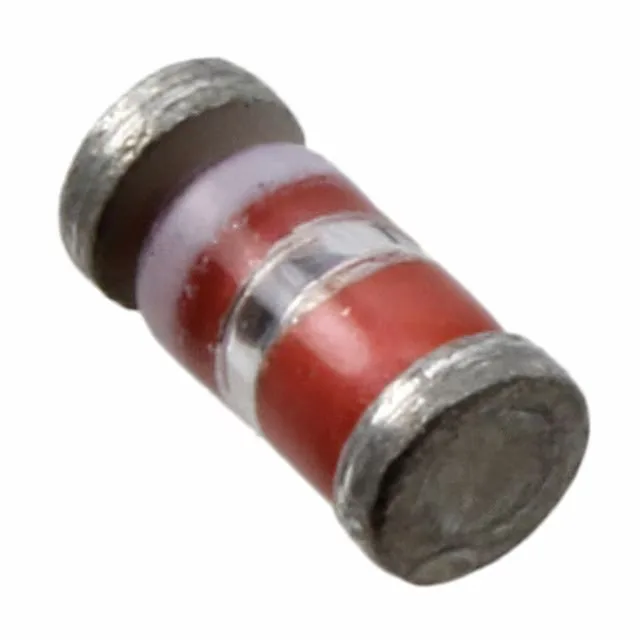
Hermetic signal diode for high-reliability boards
The 1N4148UR-1/TR is the hermetic, military-grade version of the industry-standard 1N4148 signal diode, packaged in a DO-213AA MELF body. It is a standard silicon PN-junction diode rated for 200 mA average rectified current and 75 V reverse voltage, with a 20 ns reverse recovery time that suits high-speed clamping, flyback snubbing, and logic-level translation. The DO-213AA is a glass-sealed, cylindrical surface-mount package that provides hermeticity and thermal shock resistance far beyond plastic SMD packages like SOD-123 or SOT-23. This makes it a fit for avionics, satellite, downhole, and other high-reliability environments where moisture ingress or extreme temperature cycling would crack a plastic body.
Switching speed and junction capacitance — what 20 ns trr and 4 pF mean for signal integrity
A 20 ns reverse recovery time means the diode clears stored charge quickly when switching from forward to reverse bias. In a flyback clamp across a relay coil or solenoid, a slower diode would hold conduction longer and spike the supply rail; 20 ns keeps the voltage transient within the driver's breakdown margin. Junction capacitance is 4 pF at 0 V bias, measured at 1 MHz. On a high-speed digital line (I2C, SPI, or a 10 MHz clock), a higher capacitance diode would round the edges and increase propagation delay; 4 pF is low enough to leave signal integrity intact up to roughly 100 MHz, depending on trace impedance. Forward voltage is 1.2 V maximum at 100 mA forward current. At 100 mA the diode dissipates 120 mW, which the DO-213AA body can shed into the PCB copper without exceeding the 175°C junction temperature limit. The -65°C to 175°C junction range covers military cold soak and hot reflow without parametric drift.
Active lifecycle and sourcing through independent distribution
The base product number is 1N4148, so the UR-1 suffix identifies the hermetic DO-213AA variant specifically.