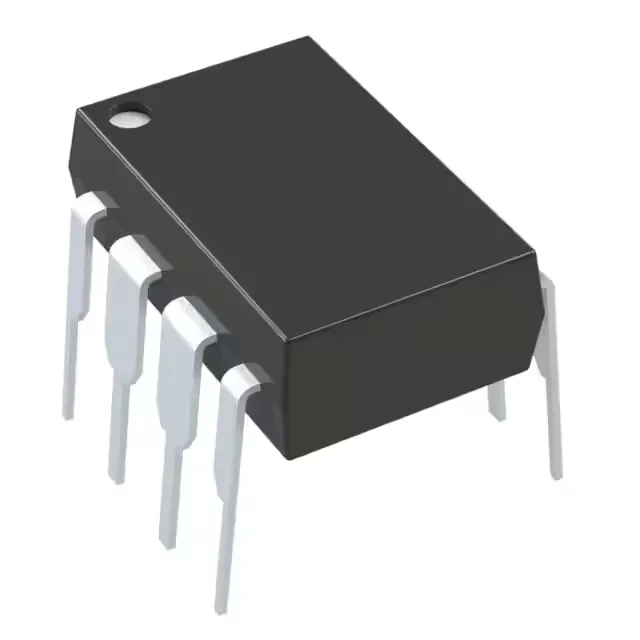
4Kbit EEPROM with a single-wire bus — what that means for pin-constrained designs
The Microchip 11LC040-I/P is a 4Kbit serial EEPROM organized as 512 x 8 bits, communicating over a single-wire interface that requires only one I/O pin on the host controller plus power and ground. For a through-hole design where every GPIO on a legacy MCU is already allocated, this frees up a port pin compared to a two-wire I²C or three-wire SPI part.
Single-wire protocol — bus timing and host-side overhead
The single-wire interface runs at 100 kHz clock frequency. The host manages the bus timing in firmware — a bit-banged GPIO routine or a dedicated UNI/O® peripheral handles the start condition, device addressing, and data transfer. Because the bus is half-duplex and the host generates the clock, the firmware overhead is higher than a hardware I²C peripheral. For applications that write infrequently — calibration constants, serial numbers, or configuration tables — the 5 ms write latency is acceptable. For high-speed data logging, a SPI EEPROM would be a better fit.
Through-hole 8-DIP — breadboard, socket, or soldered
The 8-DIP (0.300", 7.62mm) package with through-hole mounting makes the 11LC040-I/P breadboard-friendly during prototyping and field-serviceable when socketed. The tube packaging delivers the parts in a rigid anti-static carrier — suitable for manual assembly or low-volume pick-and-place with a DIP feeder. No reel or tape packaging is available for this variant.
Active lifecycle and compliance documentation
For compliance documentation, Microchip provides the standard datasheet, ROHS certificate of compliance, and material declaration. No UL, IEC, or AEC-Q qualification is listed for this part — it is a commercial/industrial-grade EEPROM, not automotive-qualified.