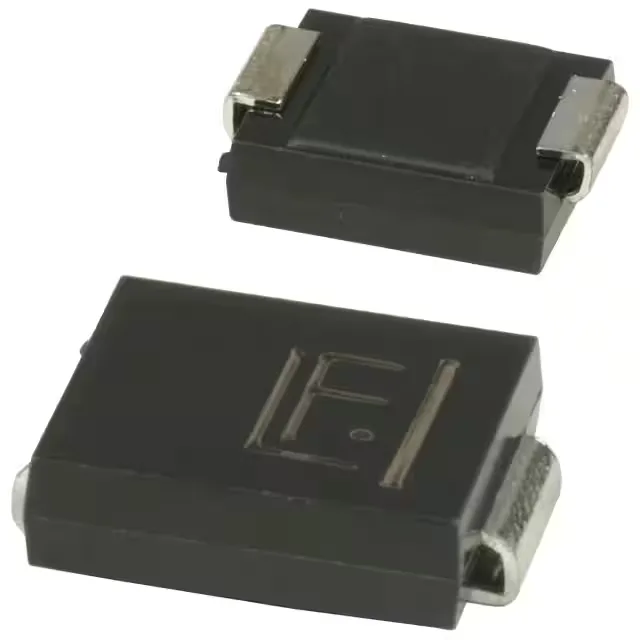
51V standoff and what that means for the rail
The 5.0SMDJ51A sits above a 51V working rail — the reverse standoff voltage is the maximum operating DC the TVS can hold off without conduction, so the protected node runs at or below this rail under normal conditions. A 51V standoff puts this squarely in the telecom base-station and DSLAM port tier, where line-card power rails commonly sit at 48 V. Selecting the standoff is the first gate: pick a TVS below the rail's normal operating voltage and it leaks or clamps continuously; pick one too far above and the protection margin is wasted.
5 kW peak pulse, breakdown floor, and clamping ceiling
When a surge arrives, the diode transitions from blocking at 51V to conducting at the 56.7V minimum breakdown voltage. The peak pulse current at that waveform is 60.7 A; this is the number a protection designer uses to verify the upstream series impedance does not exceed the diode's clamping capability. The gap between the 56.7V breakdown floor and the 82.4V clamping ceiling is the protection window: the narrower it is, the better the TVS shields sensitive semiconductors behind it. For telecom line cards with 5V or 3.3V downstream ICs, the 82.4V clamp is well within the common-mode withstand rating of most PHY transceivers.
The -65°C low end covers outdoor cabinet deployment in cold climates without a separate cold-start concern for the TVS itself. This is a unidirectional Zener-type TVS, meaning it clamps in one polarity only — bidirectional or AC-line protection requires a different polarity configuration.
DO-214AB footprint and telecom assembly flow
The DO-214AB (SMCJ) package is the industry-standard EIA-481 compliant footprint for this surge tier, available in both tape-and-reel and cut-tape packaging to match whether this is a high-volume production run or a service-bench repair quantity. Surface-mount termination supports standard IR reflow profile — confirm the solder-mask opening and pad finish with your contract manufacturer before releasing to the line, as telecom RF sections often use ENIG finish that affects the thermal profile. Power line protection is not asserted for this part — it is designed for signal or secondary rail protection, not as a mains-input surge arrestor.