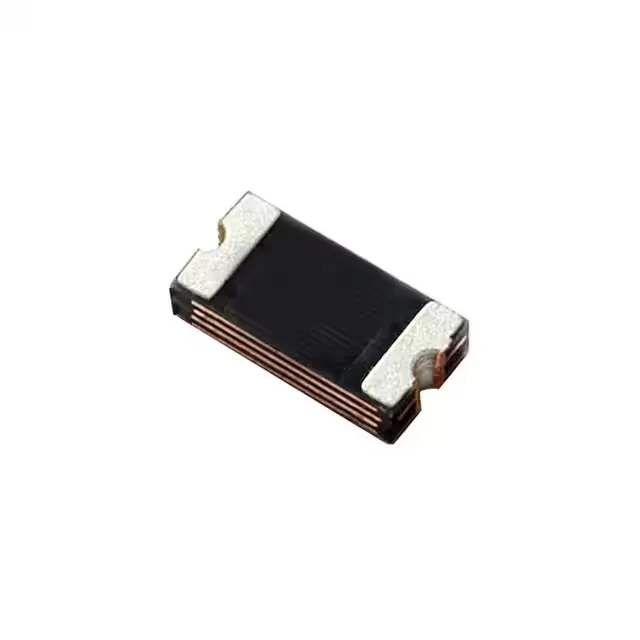
Littelfuse Inc. 1206L500SLWR — Circuit Protection

Littelfuse 1206L500SLWR POLY-FUSE LoRho, 5A Hold

MPN1206L500SLWR
Active

Littelfuse Inc. POLY-FUSE®, LoRho series, polymeric PTC resettable fuse, 1206 (3216 Metric) concave SMD package, 5 A hold current, 6 V max, 50 A max fault current.

$2.3600Ref. price · indicative, final on quote
Sourced new & surplus through independent channelsAuthenticity-screened · ESD-safe packingListing updated Aug 2026

Specifications

1206L500SLWR specifications
ParameterValue
TypePolymeric
SeriesPOLY-FUSE®, LoRho
MountingSurface Mount
Voltage - max6V
Current - max50 A
Current - trip10 A
Current - hold (Ih)5 A
Size (Dimension)0.126\" L x 0.065\" W (3.20mm x 1.65mm)
PackageTape & Reel (TR); Cut Tape (CT)
Time to trip2 s
Case1206 (3216 Metric), Concave
Thickness0.039\" (1.00mm)
Resistance - initial (Ri)100 mOhms
Resistance - post trip (R1)12 mOhms

Product details

LoRho series — low-resistance PTC for tight voltage budgets

The 1206L500SLWR: This is a polymeric PTC resettable fuse from Littelfuse's POLY-FUSE LoRho family, engineered for applications where every milliohm of series resistance matters. The initial resistance is 100 mOhms minimum, and the post-trip resistance holds at 12 mOhms maximum — an order of magnitude lower than standard PTCs, which keeps voltage drop across the fuse negligible in a 6 V rail. Rated for 5 A hold current (Ih) with a 10 A trip current (It), it handles normal operation up to 5 A and trips within 2 seconds at fault current levels. The maximum fault current it can interrupt is 50 A at 6 V, giving it solid short-circuit capability for low-voltage power distribution.

1206 footprint — standard pick-and-place fit

Surface-mount construction means it flows through reflow soldering alongside other passives — no manual assembly step.

Frequently asked questions

What is the hold current and voltage rating for 1206L500SLWR?

It holds 5 A continuously at up to 6 V, with a trip current of 10 A and a maximum interrupt rating of 50 A. The 2-second typical time-to-trip means it clears faults quickly without nuisance tripping on inrush.