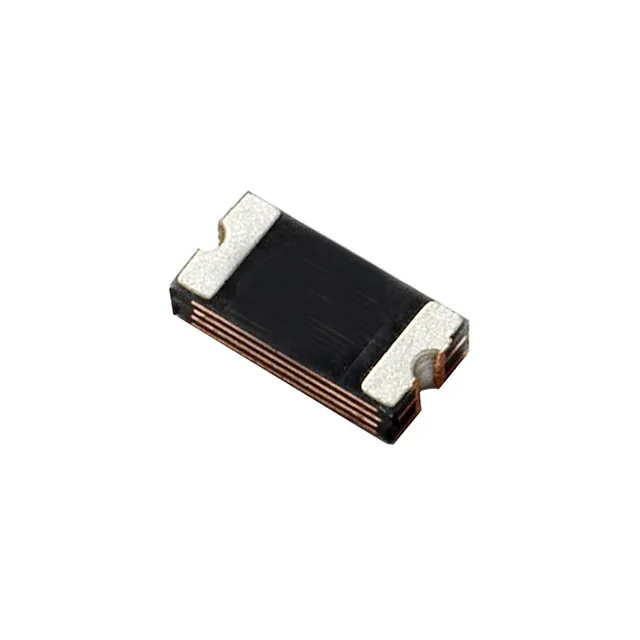
Littelfuse has marked the 1206L500SL-VYR as obsolete.
5 A hold current (Ih) at 25 °C ambient — this is the steady-state current the PTC carries without tripping. The trip current (It) is 10 A, meaning the device transitions to a high-resistance state when the fault current exceeds that threshold. Maximum fault current is 50 A at 6 V — the PTC safely interrupts faults up to that level without rupturing. The 6 V max voltage limits it to low-voltage rails (USB, battery, logic supplies). Time to trip is 2 seconds at 25 °C — this is the time from fault onset to the resistance jump. For a USB port short, 2 seconds is long enough for the upstream regulator to current-limit first; the PTC acts as a backup or over-temperature protector. Initial resistance (Ri) is 1 mOhm minimum, post-trip resistance (R1) is 12 mOhm maximum. The low Ri means minimal I²R loss in normal operation — important for a 5 A rail where every milliohm costs 25 mW of heat.
Package and board-fit
The concave termination style helps with solder fillet formation on the end caps, reducing tombstoning risk during reflow. Operating temperature range is -40°C to 85°C — standard industrial/commercial grade. The hold current derates above 25 °C; at 85 °C the 5 A rating drops to roughly 3.5 A (per the Littelfuse derating curve for the LoRho series).
Approvals and compliance
cURus and TUV approved — the part is recognized for North American and European safety standards.