What the hold current and voltage ceiling mean for your rail
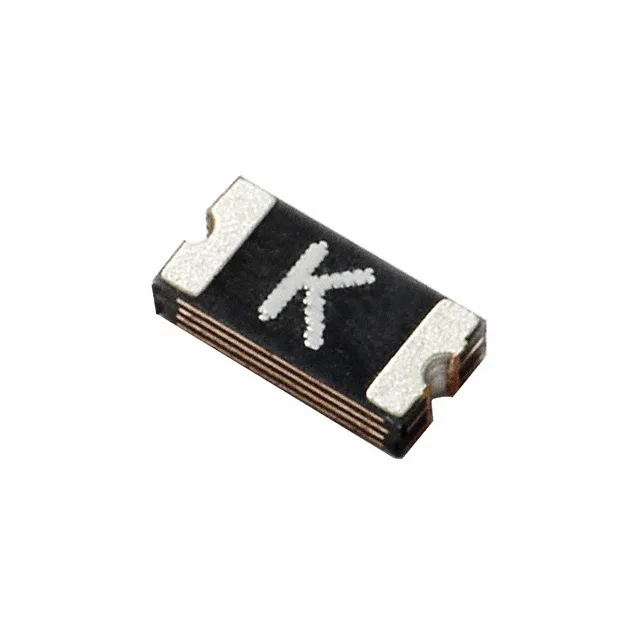
The 1206L380SLWR is a Littelfuse POLY-FUSE LoRho series polymeric PTC resettable fuse, rated for a 3.8 A hold current (Ih) at 6 V max. The 50 A max fault current rating tells you it can interrupt a short-circuit current up to that level without rupturing the package. The 3.8 A hold current is the steady-state current the part will pass without tripping at 25 °C ambient. Above that, the internal resistive heating raises the polymer temperature until it switches to a high-resistance state, typically within 3 seconds at 8 A (It). Once the fault clears and power is removed, it resets — no fuse replacement needed.
Resistance values and the LoRho advantage
Initial resistance (Ri) is 2 mOhms minimum, and post-trip resistance (R1) maxes out at 16 mOhms. The LoRho series is designed for lower resistance than standard PTCs — the 2 mOhm floor means the voltage drop at 3.8 A is under 8 mV, which keeps I²R losses negligible on a 6 V rail. That matters when you are trying to avoid a voltage sag on a USB VBUS line or a battery protection circuit. The 1206 (3216 metric) concave package is surface-mount, 3.25 mm x 1.65 mm, with a max thickness of 0.70 mm. That footprint is standard for medium-current PTCs — the concave termination allows visual solder-joint inspection after reflow. Operating temperature range is -40 °C to 85 °C, covering most indoor and outdoor consumer/industrial environments.
Lifecycle reality — obsolete, sourced through surplus
Littelfuse lists the 1206L380SLWR as obsolete. That means new designs should look at current POLY-FUSE offerings in the same 1206 footprint and similar hold-current range, but the BOM line for an existing board must be filled through independent distribution or surplus channels. The part carries cURus and TUV approvals, so it was qualified for North American and European safety standards when active. Those approvals are still valid for the existing stock — no recertification needed for repair or replacement runs.