Hold current and trip threshold — the selection anchors
The 1206L150THWR: With a 1.5 A hold current (Ih), this PTC will pass normal operating current up to that level without tripping. The trip current (It) is 3 A — when the fault current exceeds this threshold, the device switches to a high-resistance state within 300 ms (typical at specified fault current), protecting downstream circuitry. The 100 A maximum fault current rating means it can safely interrupt short circuits up to that level at the rated 8 V. This is a standard capability for a 1206-size polymeric PTC in low-voltage applications.
Resistance values and thermal budget
Initial cold resistance is 40 mOhms minimum, rising to 120 mOhms maximum after a trip event (post-trip resistance). The low initial resistance keeps I²R losses minimal during normal operation — at 1.5 A, the voltage drop is roughly 60 mV at the minimum resistance, rising to 180 mV at the post-trip maximum. This matters for low-voltage rails where every millivolt counts. Derating of the hold current at elevated temperatures follows the standard polymeric PTC curve — at 85°C ambient, the effective hold current drops to roughly 70% of the 25°C rating.
Package and board integration
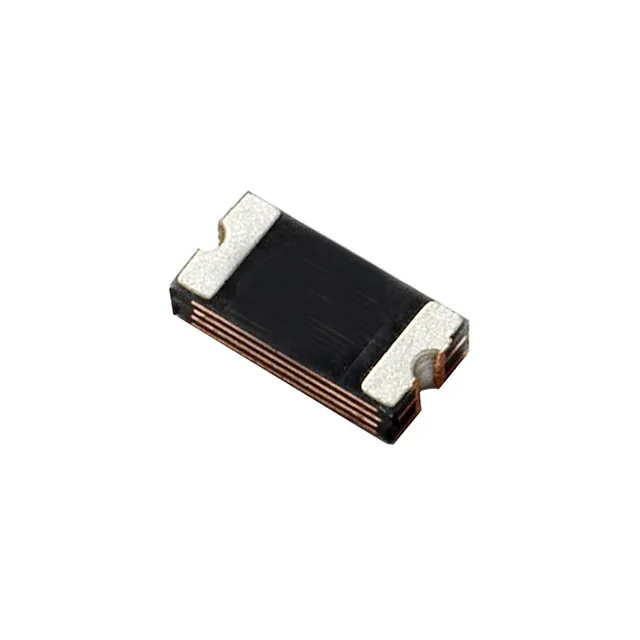
The concave termination style is standard for Littelfuse POLY-FUSE PTCs and provides good solder-joint inspection access.
Safety certifications and compliance
Approved by cURus (North America) and TUV (Europe), covering the major safety agency requirements for overcurrent protection devices. These certifications confirm the part meets UL 1434 and IEC 60738-1 standards for polymeric PTC thermistors.