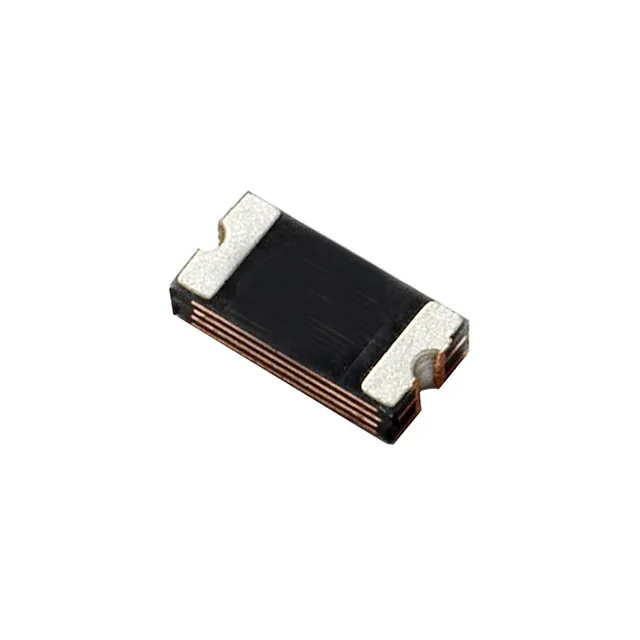
What this PTC does on the board
The 1206L110/16WR is a polymeric PTC resettable fuse from Littelfuse's POLY-FUSE 1206L series. It sits on the board as a non-destructive overcurrent protector — when a fault pushes current past its trip threshold, the polymer element heats up, its resistance jumps, and it limits the current to a safe level. Once power cycles and the element cools, it resets back to its low-resistance state. No fuse replacement, no service call.
Hold current, trip current, and what they mean for your rail
Rated for 1.1 A hold current (Ih) at 25 °C — this is the continuous current it passes without tripping. The trip current (It) is 2.2 A, meaning the device starts its resistance transition somewhere above that threshold. At 100 A max fault current and 16 V max voltage, it handles short-circuit events on low-voltage rails typical of USB, battery, or logic power inputs. Trip time is 100 ms at the rated fault condition — fast enough to protect downstream components from sustained overcurrent, but slow enough to ignore inrush from a capacitive load on the same rail. The initial resistance (Ri) is 40 mOhms minimum, and after tripping the post-trip resistance (R1) climbs to 210 mOhms maximum. That post-trip resistance is what holds the current down until the fault clears.
Package, footprint, and temperature range
The concave termination profile makes it easy to inspect solder joints under a microscope after reflow. No special pad geometry needed; it fits the standard 1206 land pattern. The hold current derates above 25 °C; at 85 °C the effective Ih is roughly half the 25 °C rating, so budget for that if the board runs hot.
Approvals and compliance
Carries cURus and TUV approvals — accepted in North American and European equipment without additional agency testing for the fuse element itself.