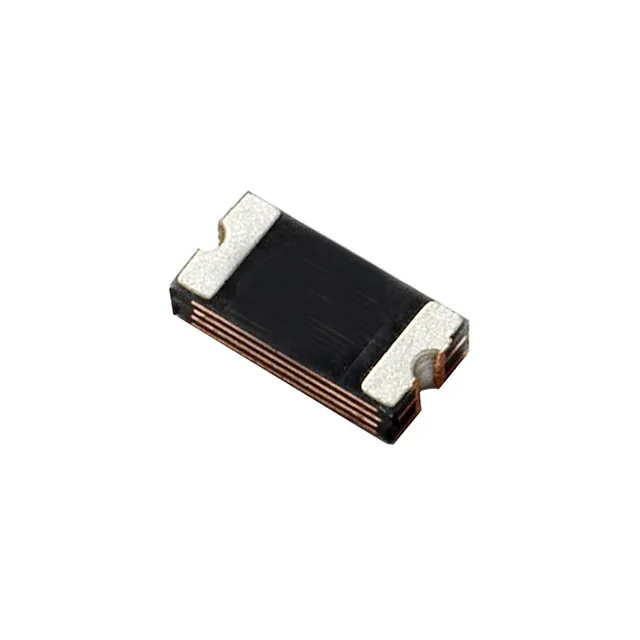
Hold current, trip current, and the reset window
The 1206L075/16WR: Rated to hold 750 mA continuously at 25 °C ambient without tripping — that is the Ih figure that governs steady-state circuit design. When the fault current exceeds 1.5 A (It), the PTC element heats and switches to a high-resistance state, limiting current to a leakage level. Trip time is 200 ms at 25 °C — fast enough to protect most low-voltage DC rails against sustained overcurrent without nuisance-tripping on inrush. The 100 A maximum interrupt rating means the fuse can handle a hard short up to that current without rupturing the package.
16 V maximum — where this fits and where it does not
The 16 V max voltage rating limits the 1206L075/16WR to low-voltage DC circuits — 5 V, 12 V, and 15 V rails are within scope. It is not rated for 24 V or 48 V industrial buses; those need the POLY-FUSE 1206L series variants with higher Vmax. Derate the hold current at the upper end of the range — the PTC's trip threshold drops as ambient temperature rises.
The concave termination profile suits standard reflow soldering and is compatible with automated pick-and-place assembly. Initial resistance is 90 mOhms minimum; after tripping and resetting, the post-trip resistance rises to 290 mOhms maximum. The low Ri keeps I²R losses under 50 mW at rated hold current, so the fuse runs cool in normal operation.
Approvals and compliance
Carries cURus and TUV approvals — the cURus mark certifies compliance with UL 1434 and CSA C22.2 No. 0.4 for polymeric PTCs; TUV indicates IEC 60738-1 compliance. These are the two most common safety standards for resettable fuses sold into North American and European equipment.