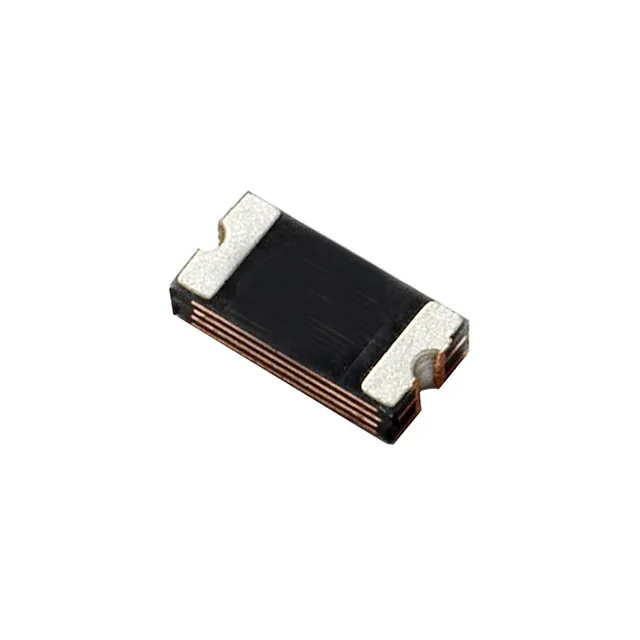
Hold current and trip current — the sizing pair
The 1206L005/60WR-A: The PTC holds 50 mA continuously and trips at 150 mA. That 3:1 ratio is typical for polymeric resettable fuses — the device stays cool at the rated load and switches to a high-resistance state when the fault current exceeds the trip threshold. At 60 V max and 10 A max interrupt current, this part clears faults in low-power DC rails — think 12 V/24 V automotive sensor supplies, or 48 V telecom line cards where a hard short would otherwise burn a trace.
AEC-Q200 qualification means the part passed automotive-grade stress tests: thermal shock, moisture resistance, mechanical shock, and vibration. This is the standard for under-hood and cabin modules that see -40°C to 85°C — an engine ECU or a body controller that lives through a northern winter and a summer heat soak. cURus and TUV approvals cover North American and European equipment safety — the PTC is accepted in UL 60950-1 and IEC 62368-1 power circuits without additional component-level testing.
Resistance and time-to-trip — the reset trade-off
Initial resistance is 3.6 Ohms minimum; after tripping it rises to 20 Ohms maximum. The 3.6 Ohm floor means a 50 mA load drops 180 mV — negligible in a 24 V rail but worth checking in a 3.3 V sensor supply where every millivolt of IR drop eats into the regulator headroom. Time to trip is 1.5 s typical at 25°C. That is fast enough to protect a wire or PCB trace from a dead short, but slow enough that a brief inrush (a capacitor bank charging) will not nuisance-trip it. At elevated ambient the trip time shortens — the polymer heats faster when the base temperature is already near the Curie point.
Package and board integration
It reflows on a standard lead-free profile and does not require a special pad layout beyond the recommended land pattern in the POLY-FUSE application note. Supplied on tape and reel or cut tape — the reel suits production pick-and-place; cut tape works for prototype builds and small-batch runs.