Peak pulse power and clamping for transient protection
The 1.5KE56CA is a 1500W (1.5kW) peak pulse power TVS diode from Littelfuse's 1.5KE series, designed to clamp transients on general-purpose DC rails. Its 47.8V reverse standoff means it sits across a 48V nominal bus without conducting, then breaks down at a minimum of 53.2V to shunt the surge. The 77V maximum clamping voltage at 19.7A peak pulse current (10/1000µs waveform) defines the voltage the downstream circuitry must survive — a 48V-rated capacitor bank with 20% margin sees 77V as a safe upper bound. This is a single bidirectional channel, so it protects both polarities from a single device — useful on AC-coupled or floating signal lines where the transient may swing either way.
Through-hole axial package and mounting
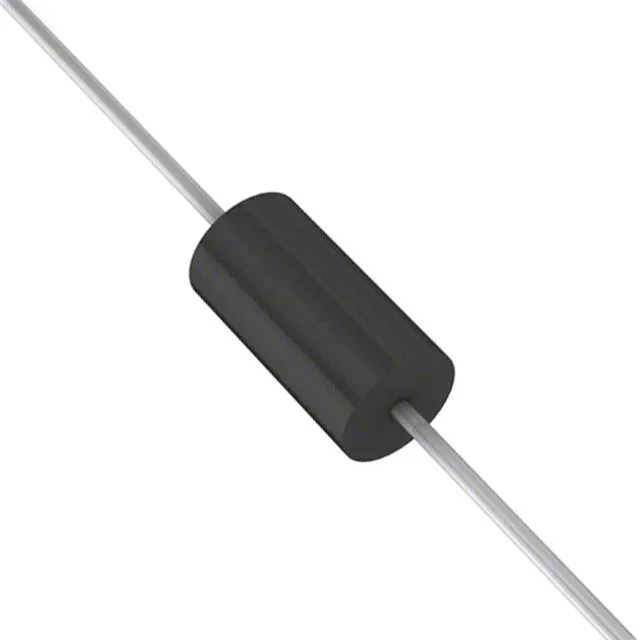
Housed in a DO-201AA (DO-27) axial-lead package, the 1.5KE56CA is a through-hole device suited for wave-solder or hand-solder assembly. The DO-201 body is standard for 1.5kW TVS diodes — the lead spacing and body diameter match common PCB layouts for 48V bus protection or DC input clamps. No power line protection rating means it is intended for signal or low-voltage DC rail transients, not mains AC clamping.