Active production — still a current-design choice
The 1.5KE480CA: This is not a last-time-buy or phase-out part; it remains a valid BOM line for new builds and replacement stock alike.
What the 1500 W peak pulse rating means for your protection budget
The 1.5KE480CA is rated for 1500 W of peak pulse power dissipation under the standard 10/1000 µs waveform. That 1500 W figure is the product of the clamping voltage (658 V max) and the peak pulse current (2.3 A) — it tells you how much surge energy the diode can absorb in a single event before the junction temperature exceeds the safe operating area. For a 408 V nominal rail (the reverse standoff voltage), this TVS starts conducting at 456 V minimum breakdown and clamps transients to 658 V maximum. The 1500 W rating means it can handle a 2.3 A surge lasting 1 ms — typical for lightning-induced transients on AC mains or industrial DC buses in the 400 V class.
Bidirectional channel — one device for symmetrical rails
This is the right choice for AC signal lines, bipolar supplies, or any circuit where the surge polarity is unknown — you get the same breakdown and clamping in both directions without needing two back-to-back unidirectional diodes.
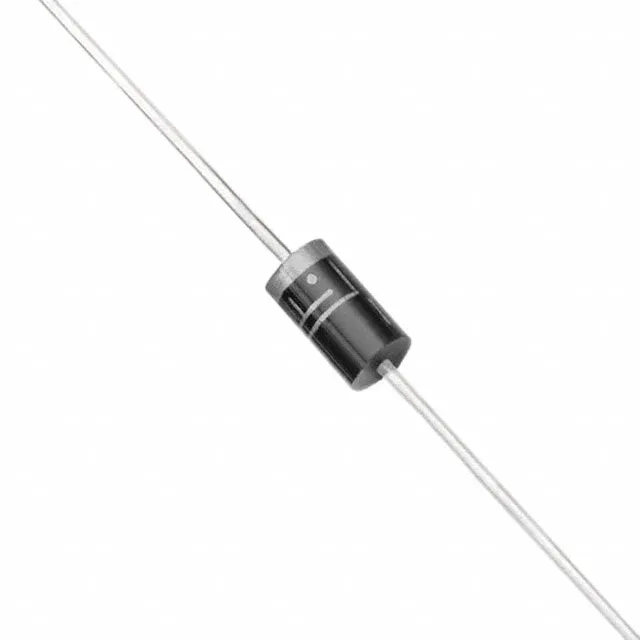
Through-hole DO-201 — the package that survives the surge
The DO-201AA axial-lead package (also known as DO-27) is a through-hole form factor rated for the full 1500 W pulse. The large body and thick leads conduct heat into the PCB copper during the surge event — the junction-to-lead thermal path is short enough that the 175 °C maximum junction temperature is not exceeded during the 1 ms pulse. The junction temperature rating of 175 °C is the absolute limit during the pulse — derate continuous power above 25 °C per the datasheet curve.