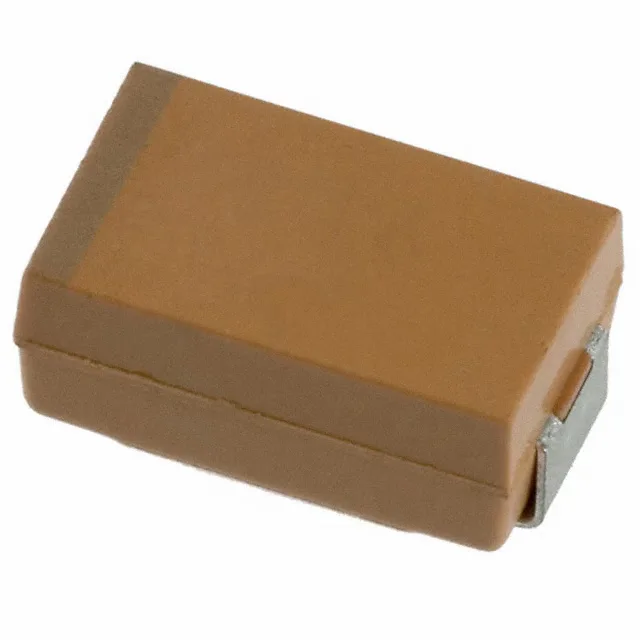
What the 40 mOhm ESR means for your rail
The TPSY157M006R0040: That ESR figure is the headline here — at 100 kHz, the impedance is dominated by the 40 mOhm resistive component, not the capacitive reactance. For a 150 µF cap, the capacitive reactance at 100 kHz is about 10 mOhm, so the total impedance is roughly 41 mOhm. The low ESR keeps ripple heating under control in a buck converter output or a processor core rail where the ripple current can hit several amps. The 6.3 V rating is the DC working voltage at 85 °C. At the full 125 °C upper limit, the derating curve typically knocks that down to about 2/3 — so 4.2 V max. If your rail is 3.3 V with a 5% transient, you have headroom at 85 °C but not much at 125 °C. The ±20% tolerance means the actual capacitance could be as low as 120 µF or as high as 180 µF — that matters for the output voltage ripple calculation, because ripple is inversely proportional to capacitance.
The 2917 (7343 Metric) case is the standard EIA size for tantalum caps in this range. The molded body has a polarity stripe on the positive end; the reflow profile for this case follows the standard J-STD-020 for MSL 3, which means a 168-hour floor life after opening the moisture-barrier bag. If the bag seal is broken longer than that, a 24-hour bake at 125 °C before reflow is the safe call.