Bulk decoupling with a known ESR ceiling
The TPSY107M010R0150: The 150 mOhm ESR is the key thermal parameter: it sets the ripple current rating and the self-heating under AC load. For a 100 kHz switching regulator output, the ripple current through this cap generates I²R losses that raise the internal temperature above ambient. The ±20% tolerance is the standard tantalum tolerance band. For a decoupling cap the exact value matters less than the minimum capacitance at the bias voltage — at 10 V the capacitance drops by roughly 10-15% from the nominal 100 µF, so the effective decoupling capacitance at the rail voltage is closer to 85-90 µF. The layout engineer should account for this when sizing the bulk cap bank for a target ripple voltage.
Footprint and board integration
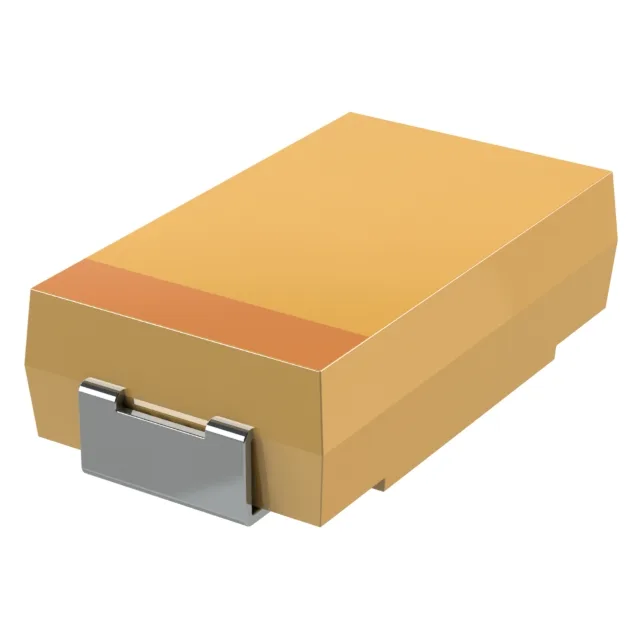
This is the standard large-case tantalum footprint shared across the TPS series and most competitive molded tantalum lines — the pad layout is interchangeable with other 2917 tantalum caps from Kemet or Vishay, so a single PCB footprint serves multiple sourcing options. The Y case code identifies this specific height variant within the 2917 family. The molded construction gives a flat top surface and consistent standoff height, which simplifies pick-and-place and reflow profiling. The TPS series is a general-purpose line — no low-ESR or high-reliability screening, so the ESR and leakage specs are the standard catalog values. For designs that need tighter ESR control or surge-current testing, the TPS series is the baseline; the TPM or THJ series from the same manufacturer would be the step-up.