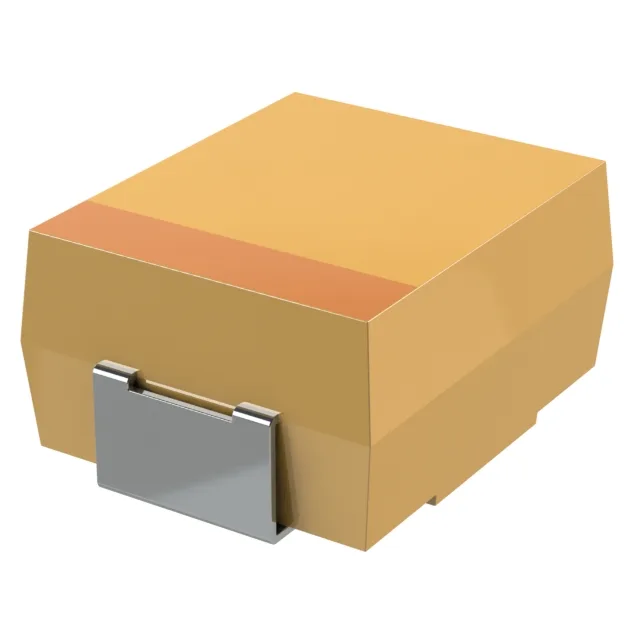
1000 µF bulk storage with 40 mOhm ESR for low-voltage rails
The TPSV108K004R0040: The 40 mOhm ESR (Equivalent Series Resistance) is the critical parameter for this part — it determines how much ripple current the capacitor can handle without excessive self-heating, and directly impacts the output voltage ripple in a DC-DC converter or the transient response in a power distribution network. With a tolerance of ±10% and an operating temperature range spanning -55°C to +125°C, this capacitor is suited for industrial and automotive-grade power supply filtering, bulk energy storage on processor core rails, and input/output decoupling in voltage regulator modules.
Active lifecycle — current production part
For a BOM line using this 1000 µF / 4 V tantalum capacitor, the active status means no immediate replacement planning is required — the part can be specified into new designs with confidence that supply continuity is maintained. Sourcing is straightforward through standard distribution against an RFQ.
What the 40 mOhm ESR means for your power rail design
The 40 mOhm ESR at 100 kHz is the figure that governs the capacitor's AC performance. In a buck converter output stage, this ESR sets the output voltage ripple amplitude for a given ripple current — lower ESR means less ripple for the same switching frequency and inductor current. The 1000 µF capacitance provides the bulk charge storage needed to hold up the output voltage during load transients. When the load current steps from 0.5 A to 2 A, the capacitor supplies the initial charge deficit before the voltage regulator loop responds — the combination of 1000 µF and 40 mOhm ESR gives a characteristic time constant of 40 µs, which is well matched to the response time of typical switching regulators operating above 300 kHz.