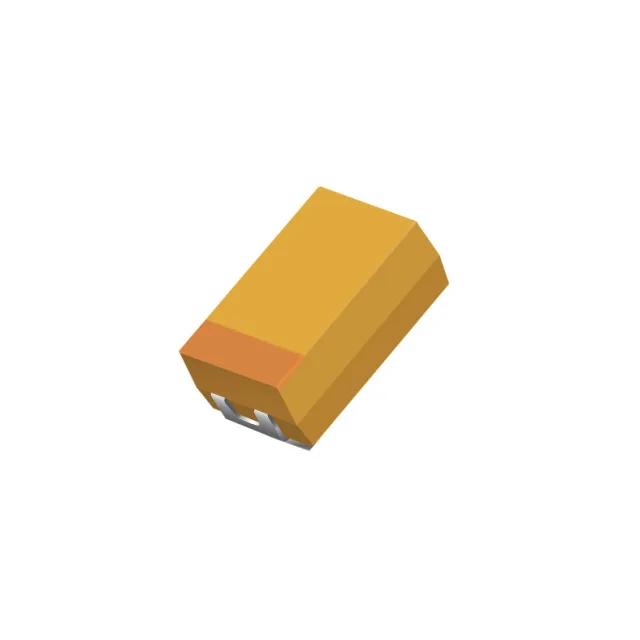
33 µF, 25 V, 400 mOhm ESR — the decoupling and hold-up capacitor for 125 °C environments
The TPSF336M025R0400: It belongs to the TPS series, positioned for general-purpose decoupling, filtering, and hold-up energy storage on surface-mount boards. The 400 mOhm ESR at 100 kHz sets the ripple-current capability and the self-heating under AC load — lower ESR means less internal temperature rise for the same ripple, which directly affects the capacitor's lifetime in a power rail.
ESR and temperature — the real-world limits
The 400 mOhm ESR at 100 kHz is the spec that governs ripple current handling. A typical tantalum capacitor's ripple current rating is sqrt(P_max / ESR), so a lower ESR allows more ripple for the same internal power dissipation. For a 33 µF part on a 25 V rail, this ESR is competitive for bulk decoupling where the AC component is modest. The 2000-hour lifetime at 125 °C implies a base failure rate that doubles every 10 °C above rated temperature — operating at 105 °C instead of 125 °C roughly quadruples the expected life. The -55 °C low end means the capacitor stays functional through cold-start conditions without the capacitance roll-off seen in some electrolytics.
No pin-compatible or functional successor cross-reference exists because the part is current-production.