Bulk decoupling and filtering in a 25 V rail
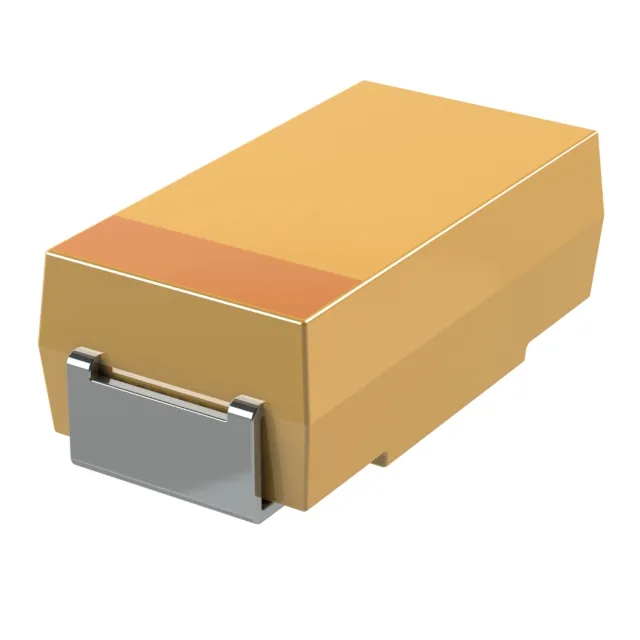
The TPSF226M025R0300: The 300 mOhm ESR at 100 kHz sets the ripple current handling and self-heating — a lower ESR means the cap can absorb more AC ripple before the internal temperature rise cuts into the 2000-hour lifetime at 125°C. The molded case provides consistent dimensional control for automated handling and reflow soldering.
Temperature range and lifetime budget
Rated for -55°C to 125°C operation, this tantalum cap covers the full industrial temperature envelope. The 2000-hour lifetime at 125°C is the endurance floor — derating the voltage and reducing ripple current extends useful life significantly in cooler environments. For a 12 V rail at 85°C, the expected lifetime is well beyond the 2000-hour figure.
ESR and its impact on circuit performance
The 300 mOhm ESR at 100 kHz is a key parameter for output filtering in DC-DC converters. A higher ESR reduces the capacitor's effectiveness at attenuating switching ripple above 100 kHz, but it also damps the LC resonance with the inductor, preventing peaking in the control loop. For a 500 kHz buck converter, this ESR value provides a good trade-off between ripple attenuation and loop stability without requiring an external series resistor. At the low end of the tolerance (17.6 µF), the ripple voltage increases by about 25% compared to the nominal value.
Board integration and footprint
The standard land pattern per the EIA-535-BAAC specification applies — a 2.5 mm pad width and 2.8 mm pad length with a 1.5 mm gap between anode and cathode pads. The molded case has a polarity mark on the top face; the anode is the larger terminal end. Tape and Reel packaging supports high-volume assembly. The reel quantity is typically 500 or 1000 pieces per reel for this case size, though the exact count depends on the supplier's packaging specification.