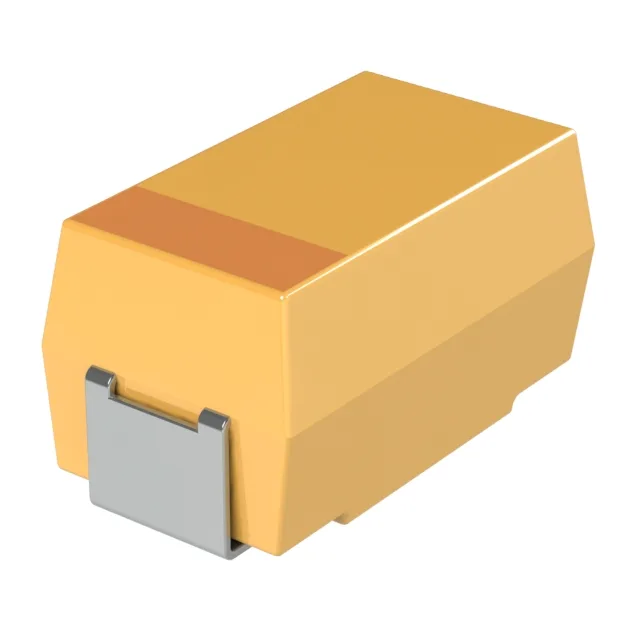
The TPSE107K016R0125: That ESR figure is the key parameter for a bulk decoupling or output filter cap: at 100 kHz switching frequencies, the impedance is dominated by the 125 mOhm ESR, not the capacitive reactance, so the ripple voltage across the cap is I_ripple × 0.125 Ω. Under rated DC bias, the effective capacitance drops by roughly 20–30% for a tantalum dielectric — so the in-circuit value is closer to 70–80 µF. Design the hold-up time or filter corner frequency with that derated figure, not the nominal 100 µF.
-55 to +125 °C — full military temperature grade
A tantalum capacitor's leakage current and ESR both increase with temperature; at 125 °C the leakage can be 10× the 25 °C value, and the ESR may rise by 20–30%. If the part sits near a hot component (a voltage regulator or processor), budget extra margin on the ripple current rating to avoid self-heating that pushes the internal temperature above the 125 °C ceiling. The 2917 (7343 Metric) case, manufacturer size code E, has a seated height of 4.30 mm max. This is a standard footprint shared with many other tantalum and polymer capacitors — the same pad layout accepts replacements from Kemet, Vishay, or Panasonic in the same case code.
The molded case construction provides mechanical robustness for automated pick-and-place and reflow soldering. The TPS series is a general-purpose low-ESR tantalum line, not a specialty automotive or high-reliability grade — so it carries no AEC-Q200 or MIL-PRF-55365 qualification. For a commercial or industrial BOM where the operating temperature stays within -55 to +125 °C, this is a cost-effective fit.