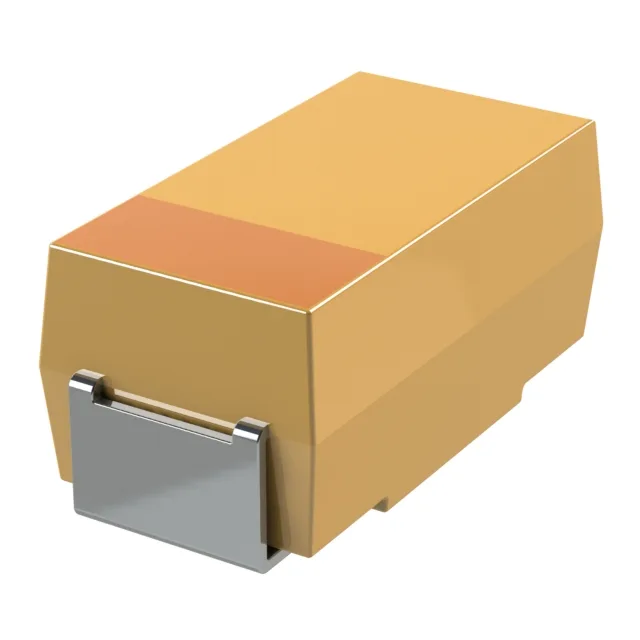
The capacitance and voltage combination fits bulk bypass on 3.3 V or 5 V supply lines where the 6.3 V rating provides 1.3 V to 2.8 V of headroom, enough to handle ripple and transient overshoot without derating concerns. The ±20% tolerance is typical for tantalum electrolytics — the actual capacitance at 0 V bias is near the high end, and it drops under DC bias.
300 mOhm ESR — ripple current and filtering trade-off
The 300 mOhm equivalent series resistance sets a ripple current limit of roughly 0.5 A RMS at 85°C (derated from the 125°C max). This is moderate for a 47 µF tantalum — it keeps self-heating under control while providing enough damping to avoid resonance with low-ESR ceramic input caps on a buck converter. For output filtering, the 300 mOhm ESR creates a zero at about 11 kHz (1/(2π47µF0.3Ω)). Below that frequency the capacitor behaves resistively; above it, the impedance drops. If your switching regulator runs at 500 kHz, the cap's impedance at that frequency is dominated by ESL, not ESR — so pair it with a 10 µF ceramic to handle the high-frequency ripple.
The molded construction (Type: Molded) resists thermal cycling cracking better than conformally coated tantalums, which matters in high-vibration environments. The 2312 (6032 Metric) surface-mount package measures 6.00 mm x 3.20 mm with a seated height of 2.80 mm max.