The 20 V rating gives headroom on a 12 V rail and comfortably handles a 5 V supply with margin for transients. Tolerance is ±10%, so the actual capacitance sits between 0.9 µF and 1.1 µF — tight enough for timing or filtering where the nominal value matters.
ESR and temperature — the hidden derating factors
The 12 Ohm ESR (Equivalent Series Resistance) is typical for a small-case tantalum at this capacitance. It limits ripple current: at 100 kHz, the self-heating from ripple current through 12 Ohm can push the internal temperature above ambient if the ripple exceeds ~100 mA RMS — check the ripple current derating curve in the datasheet. The capacitance shifts with temperature (typically +15% at -55°C, -10% at 125°C for X5R dielectrics; tantalum is more stable), so the filter corner frequency drifts less than with a ceramic cap.
Active production — no EOL worry
1206 footprint — layout and sourcing
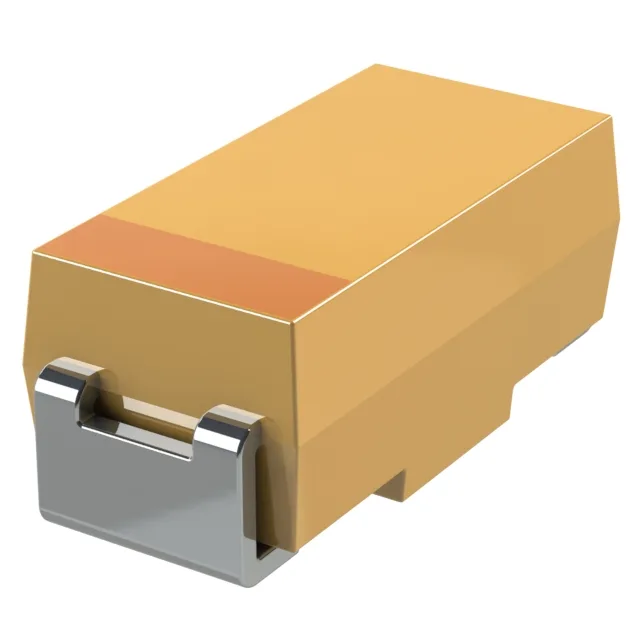
The 1206 (3216 Metric) case measures 3.20 mm x 1.60 mm with a seated height of 1.20 mm. This is a common footprint shared with ceramic capacitors of the same size, so the board layout is standard — no special pad geometry required beyond the usual 0.50 mm to 0.70 mm pad overlap per IPC-7351. The manufacturer size code 'S' corresponds to the 1206 case.