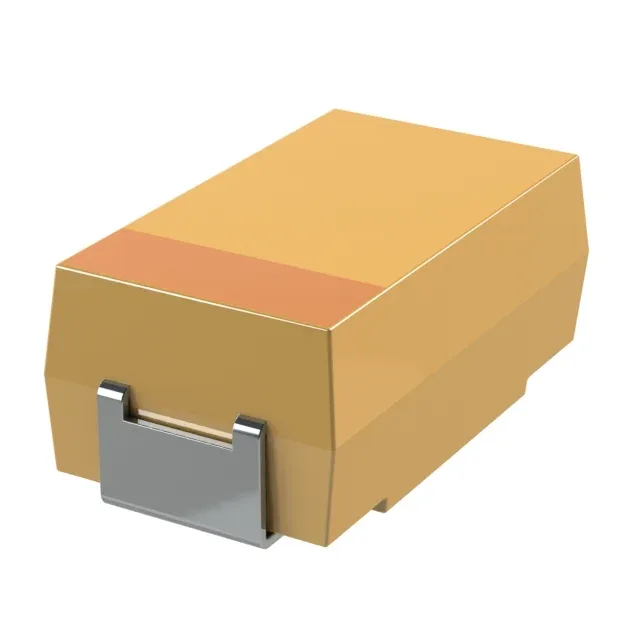
Rated 22 µF at 20 V, the TAJD226M020Y gives you 20 % derating on a 16 V rail or 75 % margin on a 12 V bus — enough headroom to keep the capacitance stable under DC bias without oversizing the case. The ±20 % tolerance means the minimum capacitance at rated voltage is 17.6 µF; factor that into the ripple-current calculation if the downstream regulator needs a minimum capacitance to stay stable.
900 mOhm ESR — the thermal budget for ripple current
At 900 mOhm, the ESR sets the self-heating under AC ripple: a 1 A ripple current at 100 kHz dissipates 0.9 W internally. That heat adds to the ambient temperature and must stay below the 125 °C ceiling. For a 100 kHz buck converter output, the ripple current is typically 30–50 % of the DC load current. A 2 A load produces roughly 0.6–1.0 A ripple — the 900 mOhm ESR keeps the temperature rise under 20 °C at that level.
At 125 °C the leakage current rises and the capacitance drifts down — the datasheet derating curve should be consulted for the actual capacitance at the high end of the range.
2917 (7343 Metric) — the D-size footprint
The 7.30 mm x 4.30 mm case matches the standard D-size tantalum footprint (EIA 2917). The land pattern is shared across AVX, Kemet, and Vishay D-case parts, so a PCB layout designed for one accepts this part without a spin.