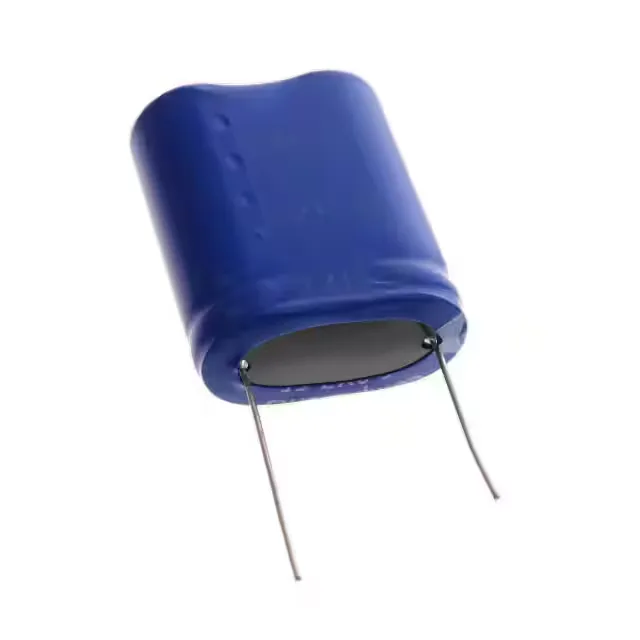
7.5 F at 6 V — the energy buffer decision
The SCMT32H755SRBB0 is a 7.5 F supercapacitor rated at 6 V, from the KYOCERA AVX SCM series. That capacitance and voltage ceiling define the energy it can hold — roughly 135 J at full rated voltage — which makes it a fit for short-duration backup, peak-power assist, or ride-through in circuits where a battery is overkill and a conventional electrolytic can't supply enough hold-up time. The 90 mOhm ESR at 1 kHz is the key spec for pulsed discharge: it limits the instantaneous current the cap can deliver without a significant internal voltage drop. A 90 mOhm ESR at 6 V means a theoretical short-circuit current of about 67 A, but in practice the usable pulse current is derated by the load and the thermal limits of the can.
Through-hole radial can — board-fit and thermal reality
The part is a through-hole radial can with 0.709" (18.00 mm) lead spacing and a body of 0.984" x 0.492" (25.00 mm x 12.50 mm), seated height up to 1.319" (33.50 mm). The PC pins terminate into a standard 0.100" pitch grid — the lead spacing is wider than a typical electrolytic, so check the PCB hole pattern before committing the layout. Lifetime is rated at 1000 hours at 65°C — the rated temperature is the ceiling, not a continuous operating target. Every 10°C below 65°C roughly doubles the expected life, so at 45°C ambient you can expect several thousand hours. The -40°C to 65°C operating range covers industrial cold starts but the upper bound is modest; keep the cap away from hot components on the board.
Tolerance and sourcing posture
Capacitance tolerance is -10%, +30% — typical for supercapacitors, where the manufacturing spread is wider than for electrolytics. A nominal 7.5 F part could measure anywhere from 6.75 F to 9.75 F at shipment. Design the hold-up time or pulse budget for the minimum, not the nominal.