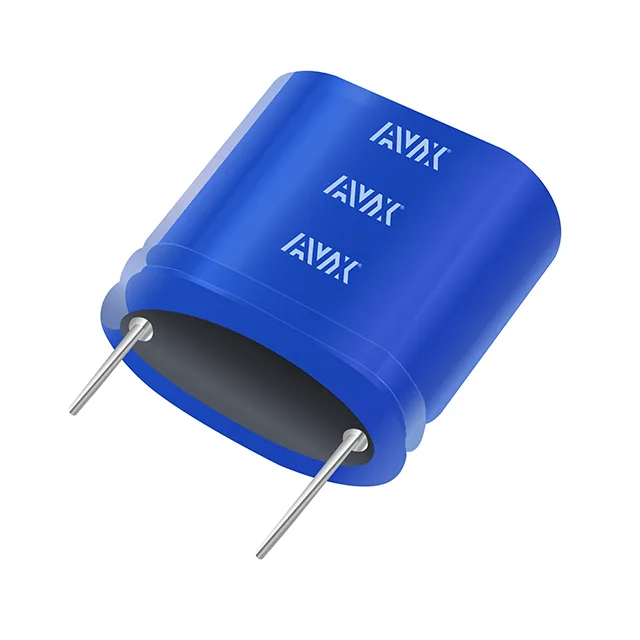
7.5 F at 5.5 V — the energy buffer window
The SCMT32F755SRBA0: Rated 7.5 F at 5.5 V, this supercapacitor stores roughly 113 J (E = ½CV²) — enough to ride through a 100 ms power gap at 1 A draw or to back up an RTC and SRAM for days on trickle charge. The -10%, +30% tolerance means the actual capacitance at delivery can land as high as 9.75 F, which shifts the hold-up time upward; the minimum 6.75 F is the conservative figure for worst-case timing calculations.
90 mOhm ESR and the ripple current ceiling
ESR is specified at 90 mOhm at 1 kHz. For a 5.5 V rail, this ESR limits the peak charge/discharge current to about 61 A in a dead-short scenario, but the practical ripple current is constrained by self-heating: at 65°C ambient, the 1000-hour lifetime rating assumes the internal temperature stays below the electrolyte's degradation threshold. A lower ESR than many supercaps in this form factor means less voltage sag under pulsed loads — relevant for GSM bursts or motor-start current.
Through-hole radial can — board integration
The 0.709-inch pitch matches standard 0.7-inch breadboard or perfboard spacing, but the 33.5 mm height demands clearance above the board — check enclosure lid clearance and adjacent tall components. Termination is through-hole PC pins; the bulk package delivers the part loose, not taped and reeled, so pick-and-place requires manual or tube-fed handling.
Temperature envelope and lifetime
Operating range is -40°C to 65°C, with a rated lifetime of 1000 hours at the upper limit. This is a standard supercapacitor endurance figure — at 45°C the lifetime roughly doubles per 10°C drop (Arrhenius rule of thumb), so a 45°C ambient yields about 4000 hours before the capacitance drops below the -30% tolerance floor. Below 0°C, ESR rises; the 90 mOhm figure at 1 kHz is at room temperature, and cold-start circuits should budget for 2–3× higher ESR at -40°C.