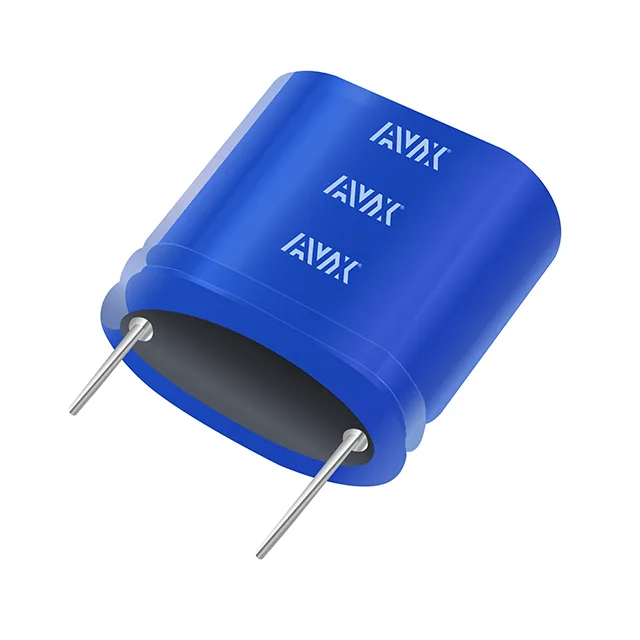
1.5 F at 5.4 V — energy buffer for hold-up and peak-power
The SCMR22D155PRBB0 is a 1.5 F supercapacitor from the KYOCERA AVX SCM series, rated at 5.4 V with a 190 mOhm ESR at 1 kHz. That ESR is the key number for a hold-up cap: it sets the IR drop during a discharge pulse. At 1 A draw, the initial drop is 190 mV before the capacitance even starts to sag — so the downstream regulator sees a clean voltage floor, not a brownout. The 5.4 V rating sits above a standard 5 V rail, giving margin for a charged supercap without needing a series diode drop. But it also means you cannot parallel it directly with a 5.0 V bus without a balancing circuit — the cap charges to the rail voltage, and if that rail is 5.0 V, the cap only sees 5.0 V, which is fine. The margin is there for the application where the bus itself is 5.4 V or where you charge the cap to its full rating.
Through-hole radial can — board footprint and handling
Packaged in a radial can with PC pins on a 0.453" (11.50 mm) lead spacing. That is a standard through-hole footprint — no special reflow profile, no moisture sensitivity. You can hand-solder it in a field repair or wave-solder it on a production line. The orientation is obvious: the can is polarized, and the longer lead is positive, same as an electrolytic. The package is Bulk — not tape-and-reel. For a through-hole part this size, bulk is the norm. If your pick-and-place handles radial parts, you will need a tube or tray feeder; otherwise it is a manual-insertion item.
Temperature range and lifetime — industrial duty
That 1000-hour figure is the accelerated life test at rated voltage and 65°C — in real use at lower temperature and voltage, the life extends significantly. At 40°C and 5.4 V, expect several years of continuous operation. The 85°C ceiling means it is fine in an industrial enclosure but not for under-hood automotive or engine-bay ambient. Tolerance is 0%, +100% — so the actual capacitance can be anywhere from 1.5 F to 3.0 F. That is typical for supercapacitors; the energy storage is dominated by the double-layer effect, not precision. Design the hold-up time for the minimum capacitance (1.5 F) and treat the extra as margin.