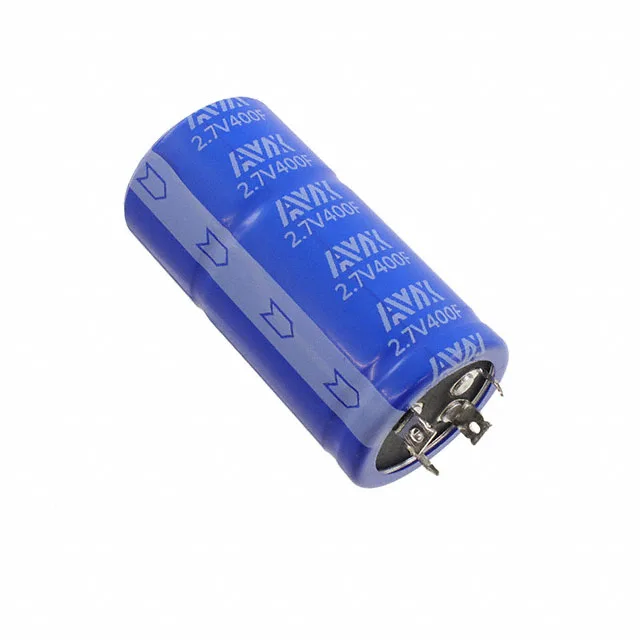
400 F energy reserve for backup and pulse loads
The SCCY68B407SSB is a 400 F supercapacitor from KYOCERA AVX's SCC series, rated at 2.7 V with an ESR of 4 mOhm at 1 kHz. That combination — high capacitance and low internal resistance — makes it a fit for applications needing a short-duration energy reserve: ride-through for a power outage long enough to write a log or park a drive, or a pulse current draw that would sag a battery below its cutoff. The 400 F figure is the headline number here — it stores about 1.46 kJ at full charge (0.5 × C × V²). For a 12 V system you would stack five of these in series, which multiplies the ESR and cuts the effective capacitance to 80 F, but the energy density still beats an electrolytic of the same can size for a 10- to 30-second hold-up window.
Thermal envelope and lifetime
Rated lifetime is 1000 hours at 60°C — that is the accelerated test condition. In practice, at 40°C ambient the expected life roughly doubles per 10°C drop below the rated temperature, so a 40°C environment should see several thousand hours before the capacitance drifts or ESR rises out of spec. The 4 mOhm ESR at 1 kHz is the AC impedance the part presents to ripple current. For a 10 A pulse, the internal heating is I² × R = 0.4 W — manageable in still air, but if the pulse train is continuous (e.g., 10 A at 50% duty), the average dissipation climbs and the lifetime derating curve in the datasheet governs the safe operating area.
Through-hole solder lug — field-fit and mounting
Termination is a solder lug on a radial can, 0.886 inch (22.5 mm) lead spacing. This is a through-hole part — it needs a hole pattern on the board and clearance above the tallest component. No lab, no bench: if the board has the footprint, you can swap it on site with a soldering iron and a desoldering pump. The tolerance is -10%, +30% on capacitance — a 400 F part could measure anywhere from 360 F to 520 F fresh from the reel. That wide spread is normal for supercapacitors; the ESR tolerance is tighter. For a balancing circuit in a series stack, the leakage current variation matters more than the capacitance spread, and the SCC series datasheet gives the leakage limits at rated voltage.