What the 6272 logic elements buy you
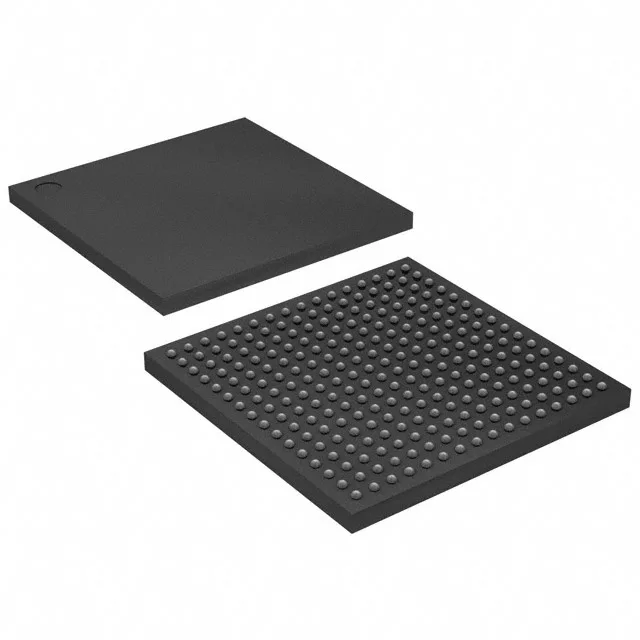
The EP4CE6F17C8: That puts it in the small-end territory of the family — enough gate budget for a 32-bit microcontroller wrapper, a few SPI/I2C/UART bridges, and some glue logic between a sensor array and a host processor, but not enough for a full video pipeline or a soft-core CPU with cache. The 179 user I/O in a 256-ball FBGA gives you headroom to route a parallel bus (say, a 16-bit LCD interface or a DDR1 controller) alongside a dozen serial peripherals without starving the pinout. The 0.80 mm ball pitch on the 17x17 mm package means a 4-layer PCB with via-in-pad is the practical minimum for fanout — two layers will struggle to escape the inner balls.
Supply rails and temperature range
That rules out a sloppy 1.2 V rail from a cheap LDO; you need a regulator with ±2% accuracy or better, and the decoupling plan on the 256-FBGA should follow the Cyclone IV pin-list guidelines for each VCCINT ball. The commercial temperature grade (0°C to 85°C junction) means this part lives in a conditioned indoor environment — no engine bay, no rooftop enclosure in July. Total embedded RAM is 276480 bits — about 34 KB — spread across M9K blocks. That is enough for a few packet buffers, a line of video at VGA resolution, or coefficient storage for a small FIR filter. If your application needs more than that, the next step up in the Cyclone IV E family (EP4CE10 with 423936 bits) is the natural migration path, though it comes in a different package and pinout.
Active production and sourcing posture
Intel still supports the Cyclone IV E family for new designs, though the 65 nm node is mature and the successor families (Cyclone V, Cyclone 10 LP) offer lower power per LE. For a repair bench or a production line that already has the bitstream and the PCB layout locked, this is the part that goes back in without a board spin. The functionally identical sibling EP4CE6F17C8N differs only in the lead finish — the N suffix indicates a lead-free (RoHS-compliant) plating. If your BOM calls for the C8N variant and you have the C8 on hand, the electricals are a drop-in swap; the only question is whether your assembly house's reflow profile and your end-customer's RoHS exemption allow the tin-lead balls on the C8.