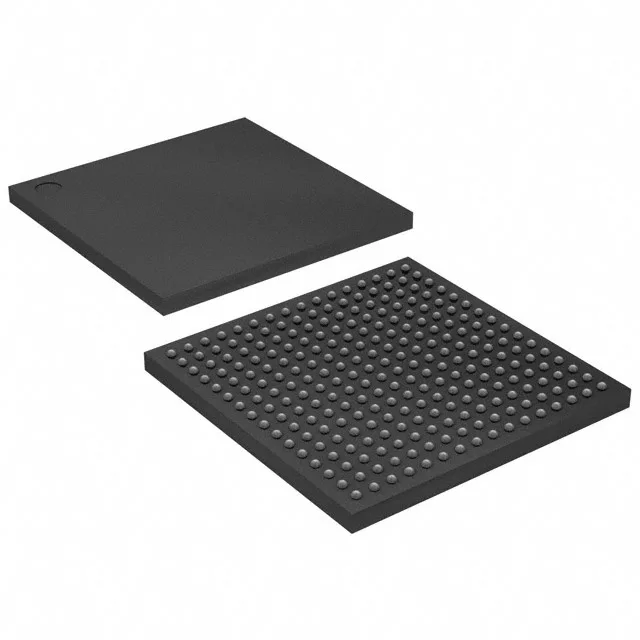
Logic density and on-chip memory for the BOM
The EP4CE30F19A7N packs 28,848 logic elements (LEs) in a Cyclone IV E fabric — enough for a moderate-complexity state machine, a soft-core processor, or a few DSP chains without external glue logic. The 608,256 total RAM bits (about 594 Kbit usable) handle small FIFOs, line buffers, or register files on-chip; if your design needs more than that, the 193 user I/O can reach an external SRAM or SDRAM. The 324-ball BGA (19x19 mm footprint) routes out on a 4-layer board with standard via fan-out; the 0.80 mm ball pitch keeps the escape routing manageable for a mid-density FPGA.
That covers outdoor telecom cabinets, engine-bay controllers, and industrial automation racks where the ambient hits 85°C and the die runs another 40°C above that under load. The -7 speed grade is the fastest in the series — the timing closure headroom at 125°C TJ is tighter than at 85°C, so budget derating in the static timing analysis.
Lifecycle status and sourcing posture
No direct replacement or second-source order code is published by Intel for this exact density and package. The Cyclone IV E family shares the same core voltage and configuration interface, so a pin-compatible migration to a larger or smaller density (e.g., EP4CE40 or EP4CE22) would require a board layout change — the ball maps differ across the 324-BGA density variants.
I/O count and package fit
193 user I/O in a 324-ball BGA — roughly 60% of the balls are signal, the rest are power and ground. That is enough for a 32-bit external bus plus a dozen LVDS pairs and a handful of control lines.