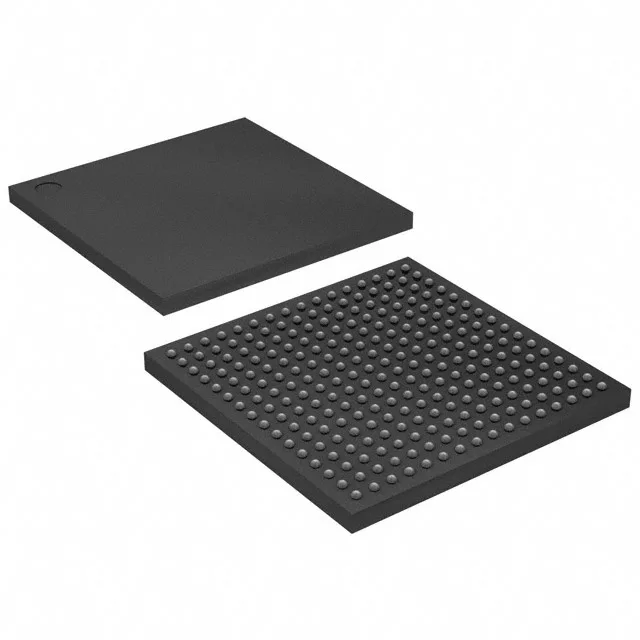
The EP4CE115F23I8LN packs 114480 logic elements (LEs) in a Cyclone IV E fabric, which is the 60 nm, low-power, cost-optimized tier of Intel's FPGA lineup. That LE count puts it in the upper-midrange of the family — enough to hold a soft-core processor (like a Nios II), a few DSP datapaths, and a modest peripheral bus without running into routability issues. Each LE contains a four-input LUT, a register, and carry logic, so the 114480 figure is the raw logic resource before any DSP or memory blocks. For a typical glue-logic or interface design, you'll consume about 60-70% of the LEs before the place-and-route tool starts struggling to close timing at 200+ MHz.
280 I/O in a 484-ball BGA — routing reality
280 user I/O escape from a 484-ball BGA (23 mm × 23 mm body, 1.0 mm ball pitch) means roughly 58% of the balls are signal pins. The remaining balls are power and ground — critical for signal integrity at the 1.0 V core voltage. You'll need at least a 6-layer PCB to fan out all 280 I/O without resorting to microvias; an 8-layer stack-up gives comfortable room for differential pairs and controlled-impedance traces. The I/O banks run at 1.2 V to 3.3 V, so the 280 pins can interface directly with common memory (DDR2, DDR3), parallel ADCs, or LVDS transceivers. No external level shifters needed for most 3.3 V logic families.
This is the standard grade for factory automation, outdoor telecom, and automotive infotainment — environments where the ambient air can hit 85°C and the FPGA's own power dissipation adds another 15°C on top. At 100°C TJ, the static power (leakage) roughly doubles compared to 85°C, so your thermal solution needs to keep the junction below that ceiling. The 484-FBGA package's exposed pad helps — a solid thermal via array under the die area drops the θJA by about 30% versus a standard BGA.