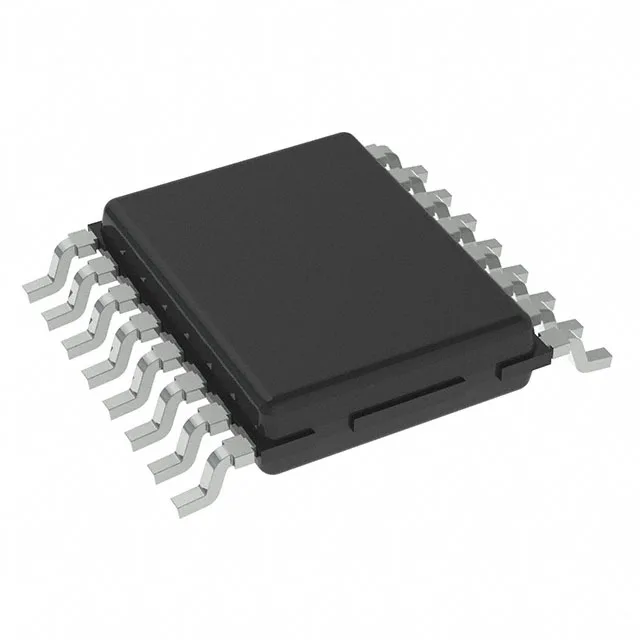
What this GMR angle sensor does on the board
The TLE5014SP16E0002XUMA1 is a giant magnetoresistance (GMR) angle sensor from Infineon's TLE5014 family, qualified to AEC-Q100 for automotive use. It outputs raw sine and cosine signals from a Wheatstone bridge, which an external ADC or microcontroller decodes into an absolute angle over 0° to 360° continuous rotation.
Sourcing and lifecycle reality for the BOM line
The TLE5014 series is current, so new designs and replacement orders are both viable. The external magnet is not included; budget for a separate diametrically magnetised magnet in the BOM.
What the sine/cosine output means for your signal chain
The sensor outputs analog sine and cosine voltages proportional to the magnetic field angle. No on-chip angle calculation — the downstream controller runs the CORDIC or lookup-table to extract the angle. That gives you flexibility in resolution and update rate, but adds a few lines of firmware. Because the output is differential Wheatstone bridge, the signal is inherently ratiometric to the 3 V supply. A stable 3 V rail keeps the angle accuracy tight; a noisy rail shows up as jitter in the decoded angle.