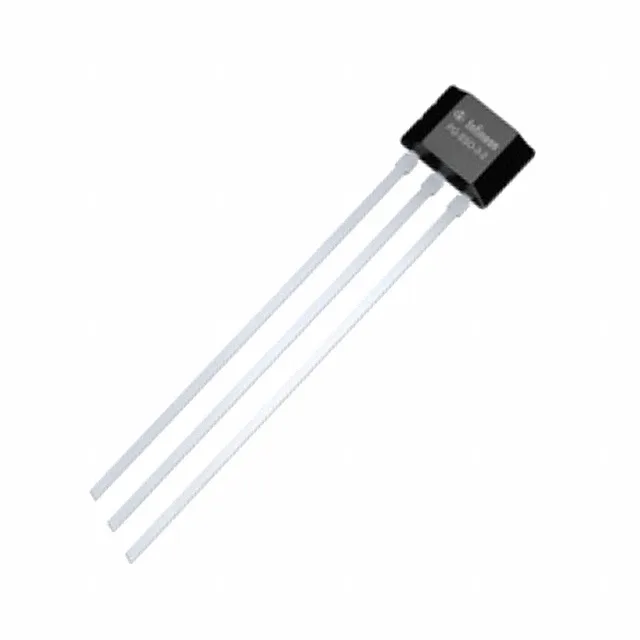
The TLE49681LHALA1 is an automotive-grade bipolar Hall-effect switch from Infineon, part of a series qualified to AEC-Q100. It operates from a 3 V supply rail and delivers an open-drain output that sinks up to 25 mA. The low 2.5 mA switching current keeps the load on the microcontroller GPIO light. The bipolar switch function means the output latches when a magnetic field of either polarity exceeds the threshold and releases only when the opposite polarity is applied — the trip points are ±2.25 mT. This makes it suitable for rotational speed sensing using a ring magnet where each pole pair toggles the output.
Temperature grade and what it means for sourcing
The through-hole SSO-3-2 package is a standard three-pin footprint that can be hand-soldered or wave-soldered — no reflow-profile concerns. Sourcing this part against a BOM line is straightforward: it is available in Cut Tape or Tape & Box from multiple distribution channels. No single-source flag — the Infineon TLE4968x family shares the same footprint, but confirm the exact magnetic threshold and temperature grade for your application before substituting.
Magnetic threshold and output behaviour
The switch responds to both north and south poles with a symmetric trip of 2.25 mT and a release of –2.25 mT. This hysteresis prevents output chatter near the threshold. Temperature compensation is built into the Hall plate to keep the magnetic thresholds stable across the –40 to 170°C range. Without it, the sensitivity would drift with the Hall coefficient and the switch point would shift by several mT over temperature.