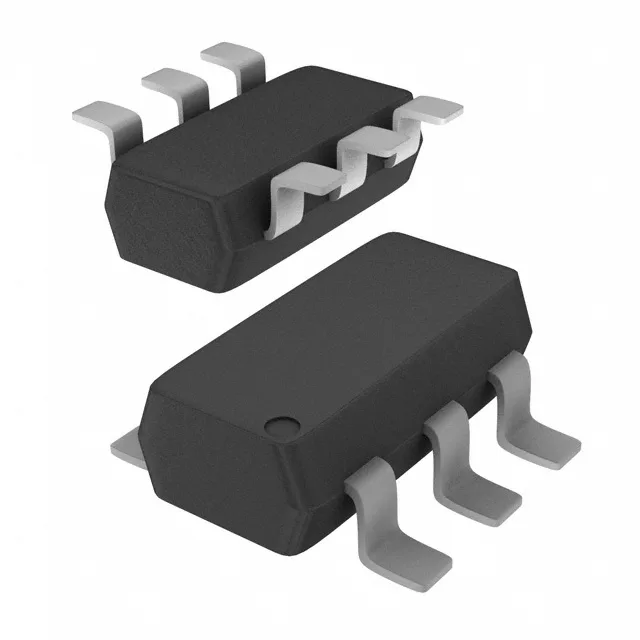
Three-axis Hall sensing in a TSOP-6 footprint
The Infineon TLE493DP2B6A3HTSA1 is a 3D magnetic Hall sensor from the XENSIV family, measuring magnetic flux density along X, Y, and Z axes simultaneously. It resolves field strength to 12 bits across a ±160 mT range, outputting digital data over an I²C interface. The sensor is programmable, allowing the user to configure measurement modes, update rates, and interrupt thresholds through the I²C bus. Housed in a PG-TSOP6-6-8 package (SOT-23-6 Thin / TSOT-23-6 footprint), it is a surface-mount part suited for space-constrained automotive and industrial position-sensing applications.
130 nA supply current — always-on capable
The maximum supply current of 130 nA is the defining power spec for this part. At that level the sensor can remain powered continuously in a battery-backed module — think electronic steering column lock, gearshift position sense, or door handle proximity — without draining the vehicle's standby budget. The supply range of 2.8 V to 3.5 V aligns with common 3.0 V and 3.3 V automotive rails; a clean 3.3 V LDO feeding this sensor and its I²C pull-ups is the typical power architecture.
Automotive temperature range and qualification
I²C interface with programmable features
The I²C output eliminates the need for an ADC on the host MCU and keeps the sensor bus simple — two wires for clock and data, plus the supply and ground. Programmability means the sensor's measurement rate, power mode, and interrupt thresholds can be set in firmware rather than fixed by external resistors. This is useful when the same PCB must serve multiple vehicle platforms with different polling requirements.