Active production — no end-of-life clock ticking
The S25FS128SAGBHM200: This means the BOM line is not under an end-of-life notice — no last-time-buy window to track, no forced redesign cycle for the memory subsystem. No stock-holding claim — quoted per RFQ.
128 Mbit at 133 MHz — read-throughput for code shadowing
128 Mbit density organized as 16 M x 8 — the byte-wide architecture maps directly to 8-bit MCU address spaces without bank switching. The 133 MHz quad-I/O read rate delivers a sustained throughput that keeps the CPU fed during execute-in-place or shadow-to-RAM boot sequences. SPI Quad I/O and QPI interface — the four-data-lane mode cuts the clock cycles per byte by 4x vs single-bit SPI. QPI mode lets the controller switch to a 4-pin address/data bus after the initial command, useful when the host has limited GPIO headroom. Supply voltage at 1.7 V — this is a true single-supply part that runs from a Li-ion cell without a boost regulator. The low voltage also reduces dynamic power during high-frequency reads.
AEC-Q100 Grade 1 — under-hood temperature envelope
This covers the engine-bay thermal profile — an ECU sitting at 105 °C on a hot asphalt road still has 20 °C of margin before the silicon's abs-max junction limit. No separate qualification run needed for PPAP submissions.
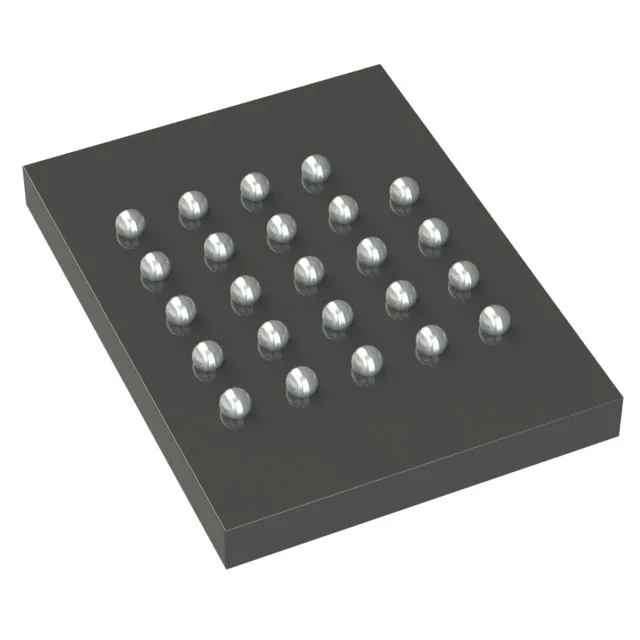
24-ball BGA — board-fit checklist
Surface-mount 24-ball BGA package. Bulk packaging means tray or tube — not tape-and-reel — so verify the pick-and-place feeder compatibility before committing to a reel-quantity order. The BGA footprint requires a solder-paste stencil with aperture diameter matching the ball pitch; a 4-layer PCB with microvia fan-out under the center balls is the standard layout.