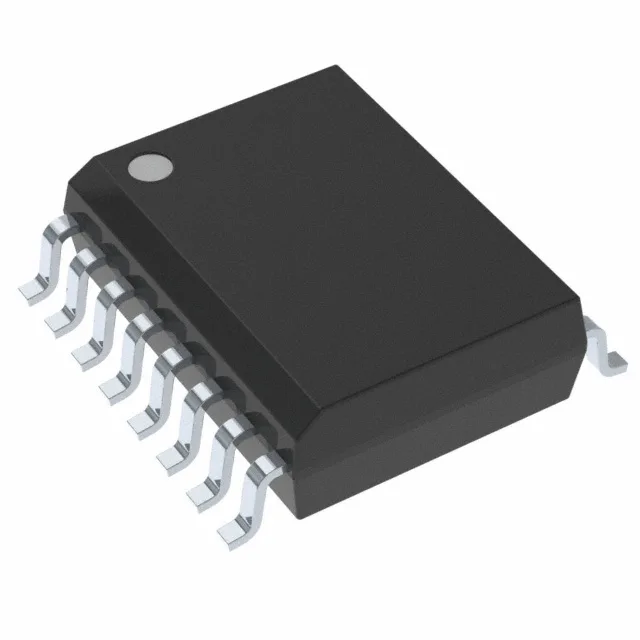
It uses a Quad I/O SPI interface running at 66 MHz, which delivers read throughput well beyond standard single-bit SPI — useful for execute-in-place (XIP) firmware boot or storing configuration tables where the processor fetches code directly from Flash.
66 MHz clock and Quad I/O — throughput for XIP
At 66 MHz, the Quad I/O interface can sustain roughly 33 MB/s read throughput in quad-output mode (assuming 4-bit data per clock). That is enough to feed a Cortex-M or low-end application processor without a separate DRAM for code storage. The part is non-volatile, so no firmware reload on power-up. For designs that already use a standard SPI Flash, switching to this Quad I/O variant can double or quadruple the read bandwidth without changing the PCB footprint — the 16-SOIC package is a common wide-body footprint.
16-SOIC wide — footprint and reflow
It is a surface-mount package suitable for reflow soldering.