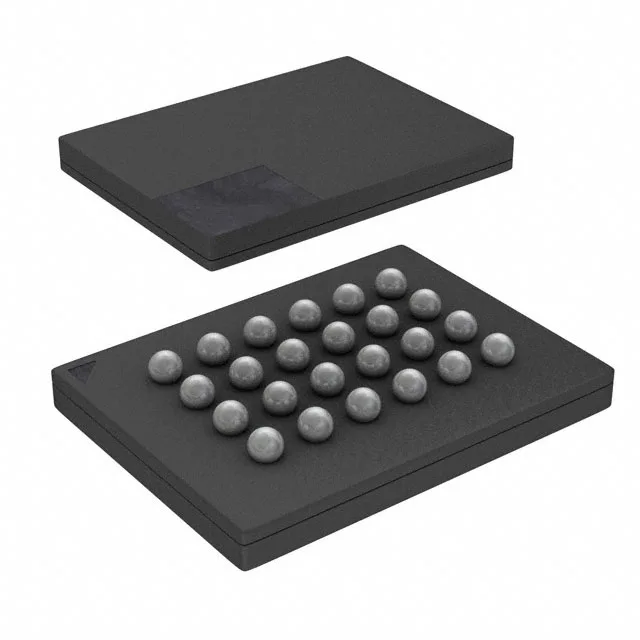
Automotive NOR Flash in a 6x8 BGA
It stores 8M x 8 bits and talks over a Quad SPI interface (SPI - Quad I/O, QPI) at clock rates up to 108 MHz. It comes in a 24-ball BGA (6x8 mm) package, surface-mount only.
108 MHz Quad SPI — what it buys you
The 108 MHz clock rate with Quad I/O gives a read throughput that keeps a modern automotive MCU fed during code shadowing or high-speed data logging. At 108 MHz in Quad mode, the effective data rate is around 54 MB/s — enough for XIP (eXecute In Place) from Flash without a separate DRAM buffer in many designs. The QPI mode reduces the command overhead by using the same four I/O lines for address and data, which helps when the host SPI controller is the bottleneck.
AEC-Q100 — the qualification that matters
If your BOM calls for an under-hood ECU, a domain controller, or an ADAS module, this qualification is the gate. Without it, the part doesn't go into the production vehicle.
BGA footprint — plan the reflow
The 24-BGA (6x8 mm) package is a fine-pitch BGA — not a hand-solderable part. The board needs a controlled reflow profile, X-ray inspection after soldering, and a stencil designed for the 0.8 mm ball pitch. The supplier device package is 24-BGA (6x8), so the footprint is compact but the assembly process is not trivial. If your shop isn't set up for BGA rework, factor in a contract assembler.
For a production BOM, it is a low-risk qualification target — no imminent obsolescence to worry about.