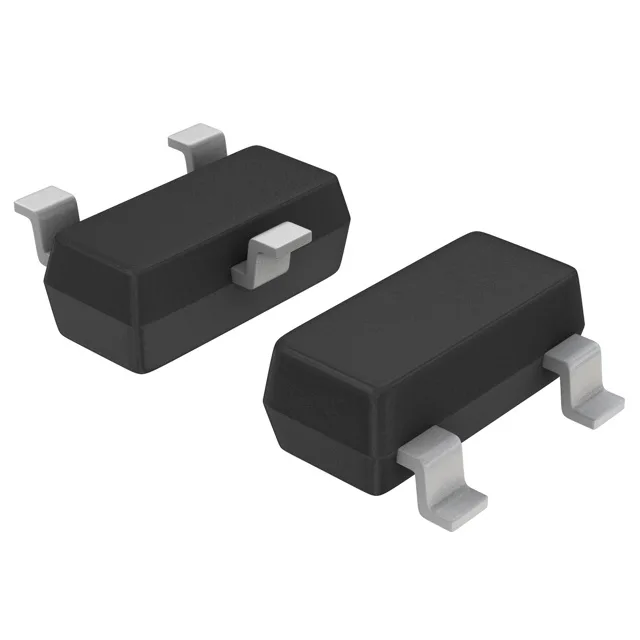
P-channel load switch in a SOT-23 footprint
Packaged in a SOT-23 (Micro3) surface-mount case, it is a common choice for high-side load switching in battery-powered and low-voltage systems where a P-channel simplifies the gate drive — no charge pump needed. The 165 mOhm maximum on-resistance at 10 Vgs keeps conduction losses manageable for loads up to a couple of amps, and the ±20 V gate-source rating gives headroom for 12 V or 15 V gate drives.
Gate drive and switching parasitics
Gate charge is 2 nC typical at 4.5 Vgs, meaning a modest GPIO pin or a small driver can switch it quickly without a pre-driver. Input capacitance Ciss is 160 pF at 25 Vds, which keeps the switching losses low in moderate-frequency converters or load switches. The threshold voltage is specified at 2.4 V maximum at 10 µA drain current, so a 3.3 V logic signal can turn it on fully — though the 165 mOhm Rds(on) figure is guaranteed at 4.5 Vgs and 10 Vgs, not at the threshold edge.
Thermal budget in a small package
The SOT-23 package limits maximum power dissipation to 1.25 W at 25°C ambient. For a 2.3 A load with 165 mOhm Rds(on), the conduction loss is about 0.87 W — that leaves only about 0.38 W of margin before hitting the thermal ceiling. In practice, derating above 25°C is necessary; a 1 A load is a safer fit for continuous operation without exceeding the junction temperature rating of 150°C.
It is ROHS3 compliant. No official replacement or second-source part is listed in the manufacturer's cross-reference.