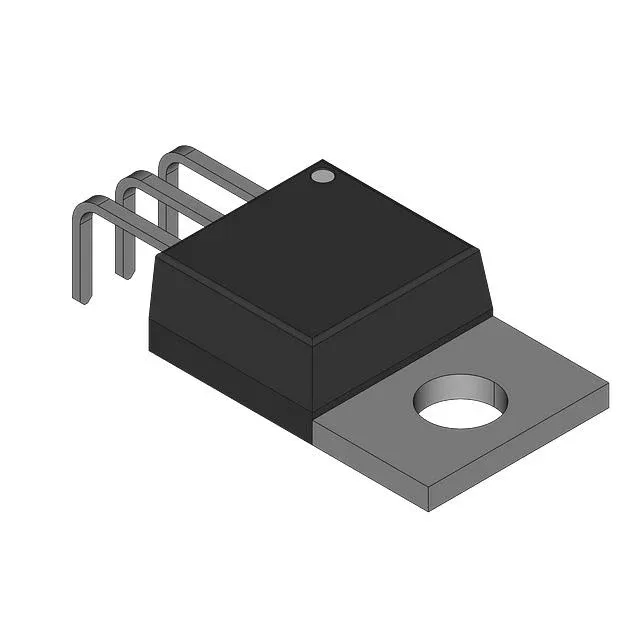
The IRGB15B60KDPBF-INF: It is designed for medium-frequency hard-switched applications such as motor drives, uninterruptible power supplies, and power-factor-correction stages where the 400 VDC rectified bus is the primary rail. The NPT structure gives a positive temperature coefficient of Vce(on), which simplifies paralleling multiple devices without current hogging — a practical advantage when scaling output current beyond a single device's rating.
Switching losses and drive requirements
Total switching energy is 220 µJ (turn-on) and 340 µJ (turn-off) under the test condition of 400 V, 15 A, 22 Ohm gate resistor, and 15 V gate drive. These numbers let the designer compute junction temperature rise at a given switching frequency; at 20 kHz hard-switched, the switching loss alone approaches 11 W, which must be sunk through the TO-220 package. Gate charge is 84 nC total, requiring a gate driver capable of sourcing and sinking several amperes peak to achieve the 34 ns turn-on and 184 ns turn-off delays. The asymmetric delay — fast turn-on, slower turn-off — is typical for NPT devices and must be accounted for in dead-time settings for half-bridge topologies.
Conduction and thermal reality for the BOM
At 31 A continuous rating, the conduction voltage will be higher due to the positive temperature coefficient; the designer should use the typical output characteristic curve for the actual operating current and junction temperature. Maximum power dissipation is 208 W, but in a TO-220 package with realistic heatsinking, continuous dissipation is thermally limited to well below that figure. The 62 A pulsed collector current rating (Icm) gives headroom for short overloads such as motor startup or capacitor charging. The integrated co-packaged diode has a reverse recovery time of 92 ns, which contributes to turn-on loss in the complementary IGBT in a half-bridge leg. This is a standard-speed diode, not an ultrafast type; for higher-frequency designs, an external fast-recovery diode may be needed.
Temperature range and deployment environments
It is ROHS3 compliant with no exemptions, suitable for EU-market equipment without restriction.