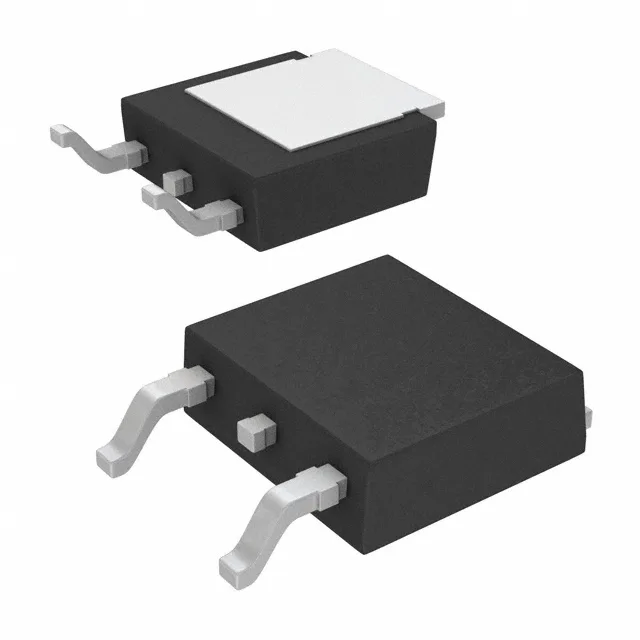
75 V, 42 A N-channel HEXFET in a DPAK — switching loss and conduction loss trade-off
The Infineon IRFR2307ZTRLPBF is a 75 V, 42 A N-channel MOSFET from the HEXFET series, built on a planar stripe technology that balances low on-resistance with moderate gate charge. The 16 mOhm Rds(on) at 32 A, 10 V gate drive means conduction losses stay under 2 W at 10 A load current, which keeps the DPAK package within its thermal budget without forced air in many industrial and automotive applications.
16 mOhm on-resistance — what it costs to switch
Rds(on) of 16 mOhm is specified at Vgs=10 V and 25 °C junction. At 100 °C junction the on-resistance roughly doubles per the normalised curve typical of planar MOSFETs, so budget 32 mOhm for worst-case conduction loss in a hot enclosure. The 75 nC total gate charge at 10 V means a 1 A gate driver can switch this FET at about 130 kHz before gate-drive losses become significant — useful for a 48 V DC-DC converter or a 12 V automotive load-switch. Input capacitance Ciss is 2190 pF at Vds=25 V. That is moderate for a 42 A device — the Miller plateau is manageable with a standard totem-pole driver, but a 10 Ω series gate resistor is advisable to damp ringing on the gate trace.
175 °C junction — where this part lives
The DPAK package (TO-252-3) has an exposed tab on the drain — the copper area on the PCB landing pad sets the thermal resistance. With 1 oz copper and a 2-inch-square pad, RthJA drops below 60 °C/W, keeping the junction under 150 °C at 42 A pulsed duty. Power dissipation is rated at 110 W at case temperature Tc=25 °C. That figure is for an infinite heatsink — real-world dissipation is limited by the PCB copper and any clip-on heatsink. For continuous 20 A load, expect the case to run 40-50 °C above ambient without a heatsink.
Active production, ROHS3 compliant — no LTB clock ticking
This is an Infineon part, not a second-source cross from another foundry.