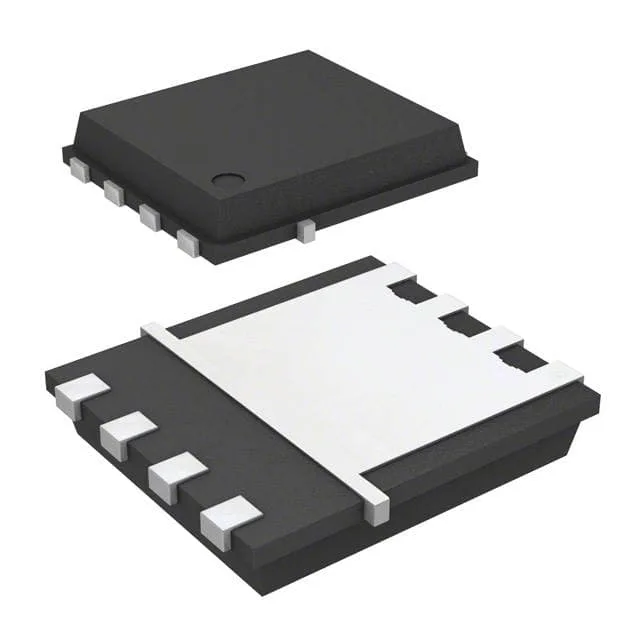
150 V, 56 A N-channel — the switching anchor for 48 V and 72 V rails
It comes in an 8-PQFN (5x6 mm) surface-mount package, the 8-PowerTDFN footprint common in mid-power DC-DC converters, motor-drive stages, and battery-management switches. The 150 V rating gives headroom for 48 V and 72 V nominal buses — including the transients on a 48 V telecom rectifier or a 72 V e-bike battery pack. The 56 A continuous drain at Tc lets it handle the full-load current of a 3 kW motor drive or a 2.5 kW DC-DC converter with adequate heatsinking.
For a 100 kHz switching frequency, the average gate-drive current is 5 mA; the peak current the driver must source for a 10 ns rise time is about 2.3 A. A standard 1 A gate-driver IC will struggle to keep the switching edges clean — budget a 2 A or higher driver for hard-switching topologies.
Package and thermal — the 8-PQFN footprint
The 3.6 W dissipation at ambient (Ta) is the free-air limit without a heatsink — for any real load above a few amps, the board copper and airflow are the thermal design.