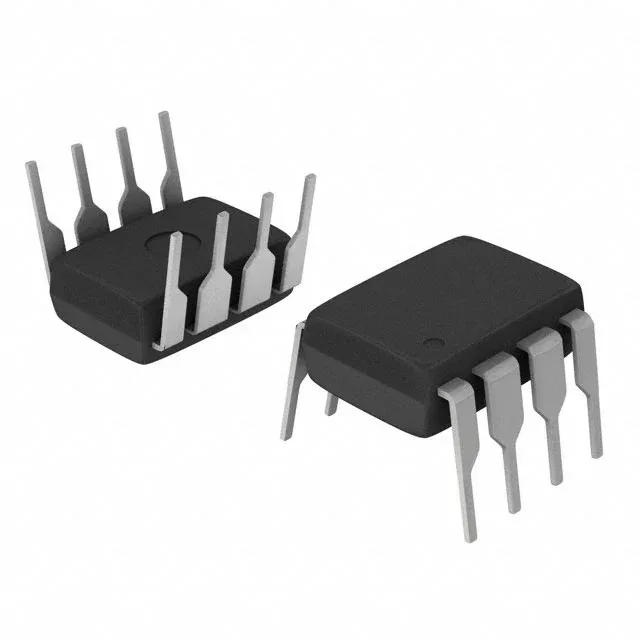
The Infineon IR2153DPBF is a self-oscillating half-bridge gate driver designed for driving N-channel MOSFETs in a synchronous half-bridge configuration. The RC input circuit sets the oscillator frequency with an external resistor and capacitor, making it a one-chip solution for the high-side and low-side gate drive in offline AC-DC converters, ballasts, and DC-DC converters up to a 600 V bootstrap rail.
600 V bootstrap and supply range — the design-in boundaries
The high-side bootstrap is rated to 600 V maximum, which covers universal AC input (85–265 VAC) rectified to a ~375 VDC bus with healthy margin. The supply voltage range is 10 V to 15.6 V — tighter than many competitors that accept up to 20 V. If your bias rail is 12 V ±5 % you are fine; a 5 V logic rail will not drive this part directly. Rise and fall times are 80 ns and 45 ns typical respectively. The asymmetric edge rates mean the dead time between high-side and low-side switching is set by the external RC, not by the driver alone — a common gotcha when swapping from a symmetric-output driver without adjusting the dead-time resistor.
NRND — plan your BOM transition
The IR2153DPBF carries a Not Recommended for New Designs (NRND) lifecycle status. For new designs, evaluate the IR2153 family or a more modern half-bridge driver from Infineon's current portfolio.
Through-hole 8-PDIP — prototyping and rework friendly
The 8-DIP (0.300-inch, 7.62 mm body) through-hole package is straightforward to hand-solder, socket, or rework — a plus for lab prototypes and low-volume builds. The 8-PDIP footprint is standard and matches the IR2153 family pinout.