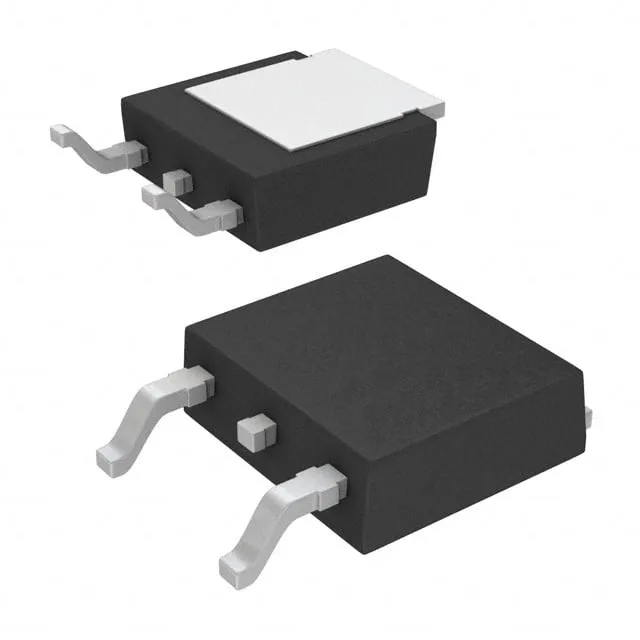
The IPD60R1K0PFD7SAUMA1: At 1 Ohm Rds(on) this is not the lowest-resistance device in the 600 V class, but the 6 nC gate charge is notably low. That means the gate-driver sees a smaller capacitive load, allowing faster turn-on and turn-off transitions. For a 100 kHz PFC stage, the reduced crossover loss can offset the higher conduction loss versus a sub-500 mOhm part. The drive voltage for minimum Rds(on) is 10 V, though the device can be driven with logic-level signals down to 4.5 V (Vgs(th) max at 50 µA) — expect higher on-resistance at lower gate voltages, so budget accordingly if using a 5 V gate drive.
Package and thermal reality in a DPak
The PG-TO252-3 (DPak) package dissipates up to 26 W at the case (Tc), but that figure assumes an ideal thermal interface. In a real layout with 1 oz copper and limited board area, the practical continuous dissipation is lower — plan for derating above 100°C junction temperature. The tab is the drain, so the PCB copper pour under the tab serves as both electrical connection and heatsink. Input capacitance is 230 pF at 400 V Vds, which keeps the switching node capacitance manageable.