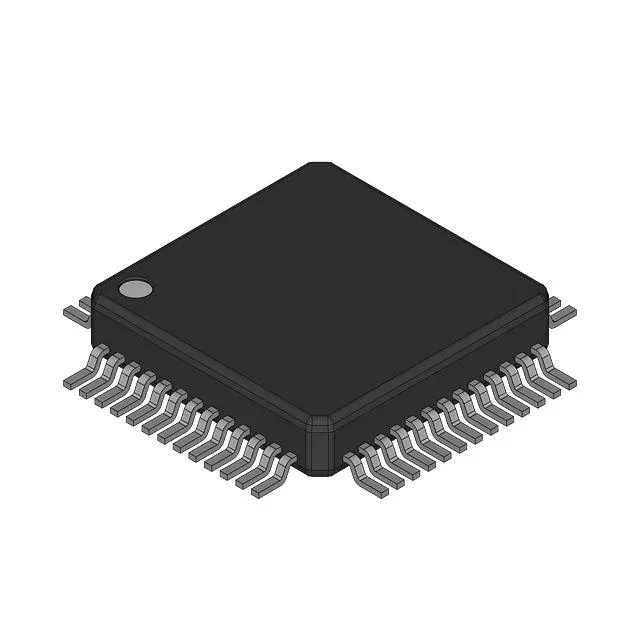
The IMIZ9973BA is a PLL-based Zero Delay Buffer from the clock-driver family, designed to regenerate a PECL input clock across a 2:13 fanout with minimal skew. It accepts a differential PECL input and delivers a single-ended clock output at up to 125 MHz, making it a fit for distributing a clean reference clock across multiple loads in telecom, networking, or industrial timing systems.
Supply rails — two ranges, one device
The supply voltage is specified across two overlapping ranges: 2.97V to 3.63V and 3.9V to 3.6V. The first range is the standard 3.3V ±10% rail common in digital systems; the second, narrower range around 3.6V suggests a separate analog or PLL supply domain. When laying out the board, plan for two independent supply nets — the core logic rail at 3.3V and a cleaner, regulated 3.6V feed for the PLL and input buffer — to avoid coupling supply noise into the output clock.
Package and footprint — 52-LQFP with 10x10 mm body
Housed in a 52-lead LQFP (10x10 mm body), the IMIZ9973BA is a surface-mount part suited for automated assembly. The 52-TQFP supplier package code matches the 10x10 mm footprint common to many clock and PLL devices.
Lifecycle and compliance — active but non-RoHS
That is good news for BOM stability — no last-time-buy scramble in the near term. However, it is marked RoHS non-compliant, which restricts its use in markets requiring RoHS conformance (EU, California, etc.). If your design targets a region with RoHS exemptions or you hold a legacy BOM that allows lead-bearing solder, this part fits; otherwise, plan for a compliant alternative or verify the exemption status.