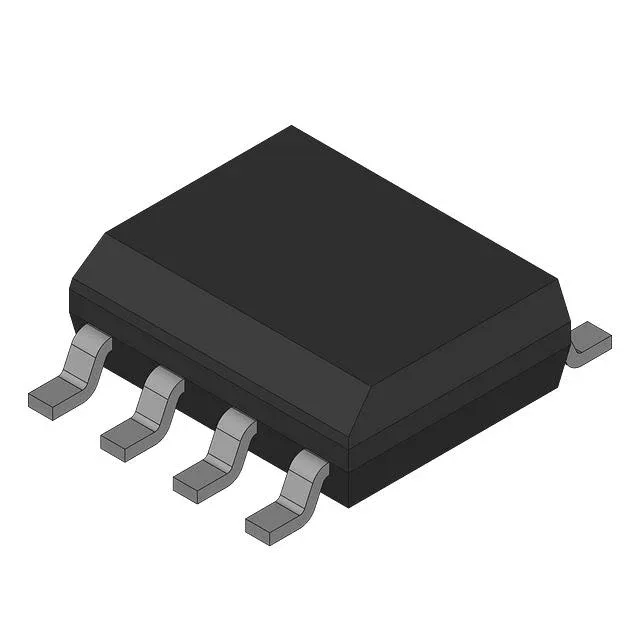
The IMISM560BZ is a spread spectrum clock generator from the IMISM560 family, designed to reduce electromagnetic interference (EMI) by modulating the output clock frequency over a small range. It integrates a PLL that accepts a clock or crystal input and delivers a single CMOS clock output at up to 108 MHz. Packaged in an 8-pin SOIC (3.90 mm width) for surface-mount assembly, the IMISM560BZ uses a 1:1 input-to-output ratio and does not support differential signalling — the input and output are both single-ended CMOS.
The integrated PLL allows the IMISM560BZ to multiply a lower-frequency crystal or clock input up to 108 MHz, but the divider/multiplier is listed as Yes/No — meaning the PLL can multiply the input frequency but does not include a programmable divider on the output. The spread spectrum modulation is the primary feature: it spreads the output energy across a small frequency band, reducing peak EMI at the fundamental and harmonics. For a design engineer, this means the part can help pass FCC or CISPR Class B radiated-emission tests without a metal shield or ferrite bead on the clock trace. The 1:1 input-to-output ratio means every input clock cycle produces exactly one output cycle — no fanout, no division. If the system needs to drive multiple loads, a separate clock buffer or fanout device must follow the IMISM560BZ.
RoHS non-compliance — legacy solder process required
The IMISM560BZ is marked RoHS non-compliant. This is a lead-bearing part, which means it cannot be used in a standard lead-free (Pb-free) reflow process without a specific exemption or a dedicated tin-lead solder line. For repair technicians, the scorch mark on a failed board is often a lead-free joint that cracked — this part's leaded solder joints are more ductile and less prone to thermal-cycle fatigue in commercial equipment.
There is no last-time-buy window, no end-of-life notice, and no official successor.