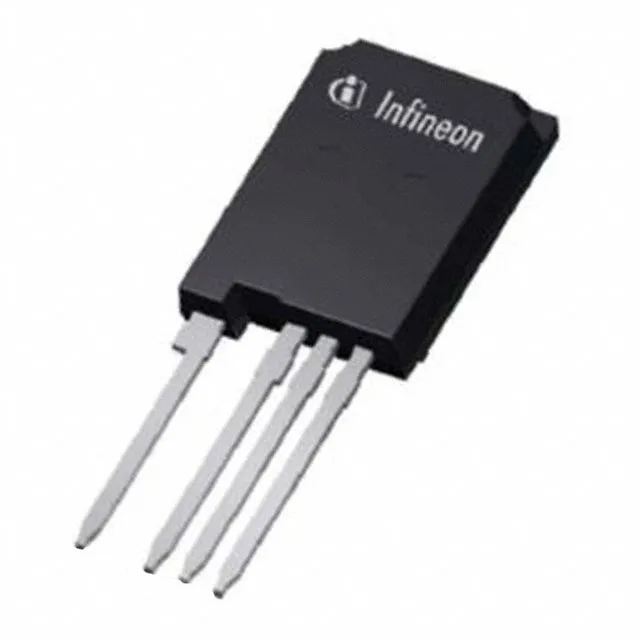
1200 V, 80 A TrenchStop IGBT for motor-drive and power-conversion stages
The Infineon IKY40N120CS6XKSA1 is a TrenchStop Trench Field Stop IGBT rated for a 1200 V collector-emitter breakdown and 80 A continuous collector current, packaged in a TO-247-4 through-hole case. It targets the main switching element in motor drives, uninterruptible power supplies, solar inverters, and welding equipment where 600 V to 800 V DC-link voltages are common and the 1200 V rating provides the necessary voltage margin for transient overvoltages. The 500 W maximum power dissipation and 175 °C maximum junction temperature allow sustained operation in high-ambient enclosures typical of industrial drives, provided the thermal path through the TO-247 package to a heatsink is properly managed.
At the test condition of 600 V, 40 A, 9 Ohm gate resistor, and 15 V gate drive, the IKY40N120CS6XKSA1 dissipates 1.45 mJ during turn-on and 1.55 mJ during turn-off. These switching energy figures, combined with the 285 nC total gate charge, define the trade-off between switching frequency and thermal budget: a 20 kHz hard-switched inverter will add roughly 60 W of switching loss per device at the test current, which must be sunk by the heatsink alongside the conduction loss. The 27 ns turn-on delay and 315 ns turn-off delay at 25 °C set the minimum dead-time window the gate driver must respect to avoid shoot-through. The 255 ns reverse recovery time of the internal diode (or an external freewheeling diode) factors into the commutation loop design.
Package and mounting: TO-247-4 with Kelvin-emitter pinout
The PG-TO247-4-2 package has four pins: the fourth pin is a Kelvin emitter connection that separates the power current path from the gate-drive return path. This reduces the voltage drop in the gate-emitter loop caused by the stray inductance of the main emitter bond wire, giving cleaner gate waveforms and faster switching edges than a standard three-pin TO-247. Through-hole mounting with a TO-247 footprint requires a heatsink with a flat mounting surface and a thermal interface material rated for the 175 °C junction temperature. The collector tab is electrically live at the DC-link potential, so the heatsink must be electrically isolated or grounded appropriately.