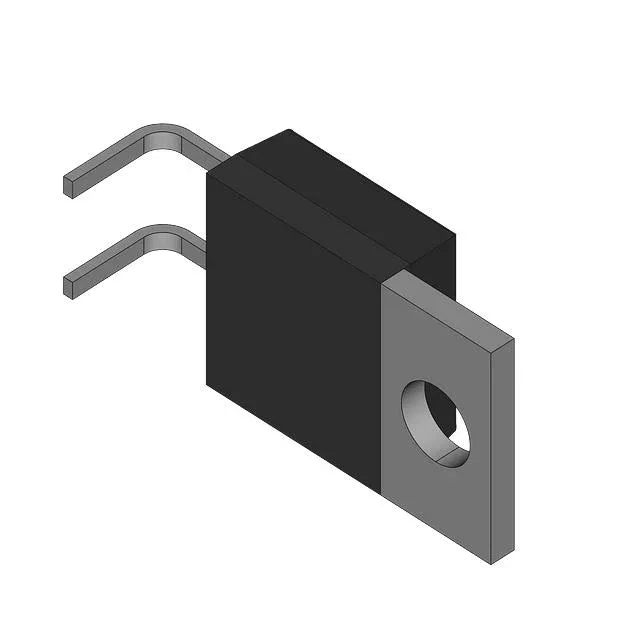
650 V, 15 A fast recovery — the switching-loss tradeoff
The 47 ns trr is the headline parameter. In a continuous-conduction-mode PFC stage or a 100 kHz LLC converter, that recovery charge directly sets the turn-off loss in the diode and the turn-on loss in the companion MOSFET. A standard 200 ns recovery diode would roughly quadruple the switching loss at the same frequency — the 47 ns trr keeps the thermal design manageable without moving to a SiC Schottky. Forward voltage is 2.2 V maximum at 15 A and 25 °C junction. That is the conduction-loss floor at full load — at 15 A average, expect about 33 W of forward drop loss before any temperature derating.
The 175 °C Tj rating means the die attach and passivation are built for the higher end of the industrial temperature envelope, not just 150 °C commercial parts.