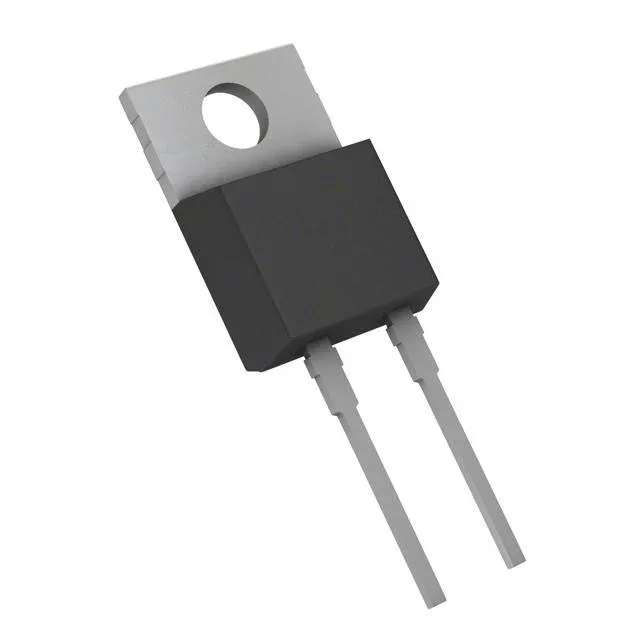
1200 V, 50 A fast recovery diode — the TO-220-2 workhorse for hard-switched power stages
The Infineon IDP30E120XKSA1 is a general-purpose fast recovery diode in a TO-220-2 through-hole package, rated for 1200 V DC reverse voltage and 50 A average rectified forward current. Typical applications include boost PFC stages, output rectification in offline flyback converters, snubber clamps, and freewheeling diodes in motor drive inverters where the DC bus is 600–800 V and the switching frequency stays under 50 kHz.
The 243 ns reverse recovery time is the key switching parameter. In a continuous-conduction-mode PFC or hard-switched inverter, the diode's reverse recovery charge contributes directly to the turn-off loss in the companion MOSFET or IGBT. A 243 ns trr is typical for a 1200 V fast epitaxial diode — it reduces the recovery spike and the associated EMI compared to a standard recovery part, but it still requires a snubber or careful layout when the switching frequency pushes past 30 kHz. The forward voltage is 2.15 V at 30 A, so conduction loss at full load is around 100 W — the TO-220-2 package needs a heatsink sized for that dissipation, especially at the 150 °C junction temperature limit.
Package and thermal reality — TO-220-2 with the PG suffix
The package is a standard TO-220-2 with the Infineon PG-TO220-2-2 variant — two leads, a metal tab that is electrically the anode (common cathode on the tab), and a 3.2 mm mounting hole for a screw or clip to the heatsink. The junction-to-case thermal resistance is not listed in this evidence, but for a 50 A diode in a TO-220, the tab must be bolted to a heatsink with thermal compound; the 150 °C junction limit is reachable with a few tens of watts of dissipation. The through-hole mounting is straightforward for wave-solder or hand-solder assembly, and the package is widely second-sourced across the industry.