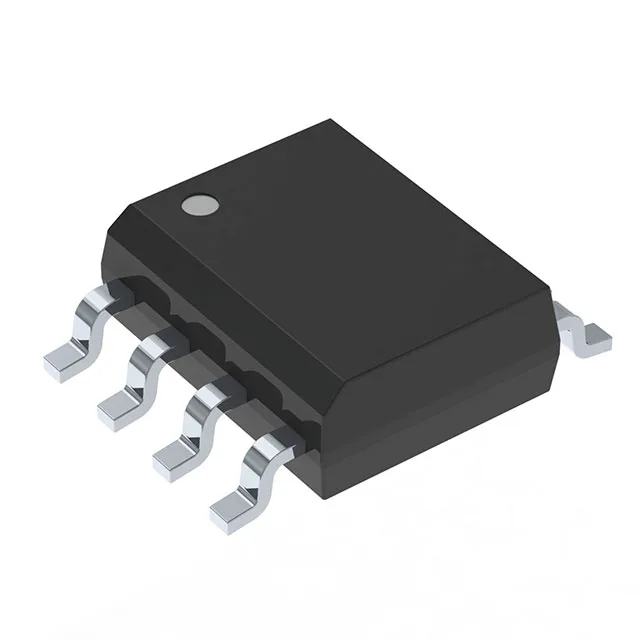
Flyback controller with integrated protection — what the specs mean for your design
The ICE2QS03GXUMA1 is a current-mode offline PWM controller built for isolated flyback topologies. It does not include an internal power switch, so an external MOSFET is required — the controller drives the gate directly. The fixed 52 kHz switching frequency sets the transformer design: at this frequency, a typical EE16 or EE20 core with a 1:1 turns ratio delivers ~10-15 W depending on the input voltage and duty cycle. The 50% maximum duty cycle limits the transformer reset time — the secondary winding must deliver the output during the off-time, which constrains the output voltage ripple and the required output capacitance. For a 5 V output at 2 A, the secondary diode sees roughly 2× the reflected voltage; the 50% duty keeps the diode voltage stress manageable. Fault protection covers five conditions: current limiting, open loop, overload, over-temperature, and over-voltage. The open-loop detection is particularly useful: if the feedback path opens (e.g., an optocoupler fails), the controller enters auto-restart instead of running the output unregulated. The over-temperature shutdown uses the junction temperature sensor — the 150 °C absolute-max junction is the hard ceiling; the thermal shutdown threshold is typically 140 °C, giving 10 °C margin before damage.
Supply rails and startup — staying inside the Vcc envelope
The controller's Vcc range is 10.5 V to 27 V. The startup threshold is 18 V: the controller begins switching only when the Vcc pin reaches 18 V. Below that, the internal startup cell charges the Vcc capacitor from the rectified mains. Once running, the auxiliary winding takes over. If the auxiliary voltage drops below the undervoltage lockout (typically 9 V), the controller stops switching and re-enters startup — the Vcc capacitor must be sized to hold the voltage above UVLO during the startup transient. The 8-SOIC package has a junction-to-ambient thermal resistance around 120 °C/W on a standard 2-layer board. At 150 °C junction max, the allowable power dissipation is roughly 1 W at 85 °C ambient. The controller itself draws about 2-3 mA typical, so the dissipation is negligible — the thermal limit is driven by the external MOSFET, not the controller. The PG-DSO-8 is Infineon's designation for the same 8-SOIC footprint.
Active production and compliance — sourcing posture
The part is ROHS3 compliant, meaning it meets the EU RoHS directive with no exemptions for restricted substances. Sourced through independent distribution channels. No pin-compatible second-source or successor is listed on this record.