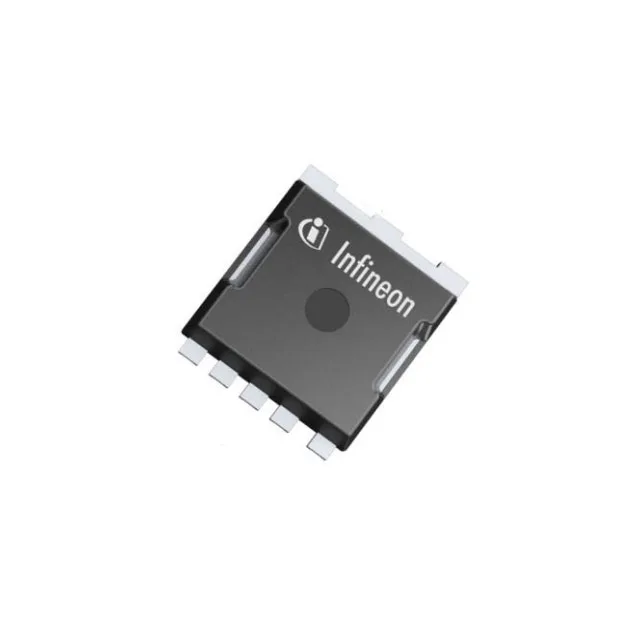
In a 40 V, 51 A continuous-drain part, that Rds(on) keeps conduction losses under 2 W at full rated current — a meaningful margin for the thermal budget in a compact PowerSFN package.
Total gate charge Qg is 109 nC at 10 V. With an input capacitance Ciss of 7088 pF at 25 V drain, the driver must source about 1.1 A peak to switch the gate in 100 ns — a standard automotive gate-driver IC handles that, but the PCB layout from driver output to the PG-HSOF-5-1 gate pad needs a low-inductance loop to avoid ringing. The drive voltage range for minimum Rds(on) is 7 V to 10 V, with a maximum gate-source rating of ±20 V. That gives headroom for a 12 V automotive rail without a clamp, but the 3 V threshold at 90 µA means the MOSFET is fully off below 3 V — important for a 5 V logic-level drive scenario.
AEC-Q101 and the 175°C junction — automotive-environment fit
AEC-Q101 qualification covers the device for stress tests specific to automotive electronics — temperature cycling, high-temperature reverse bias, and humidity. Power dissipation is rated at 172 W at case temperature Tc. That figure assumes an infinite heatsink; in a real automotive ECU on a 2-layer board with 1 oz copper, the practical dissipation is lower — the 51 A continuous drain rating at 25°C ambient is the more realistic operating limit for a 40 V bus.