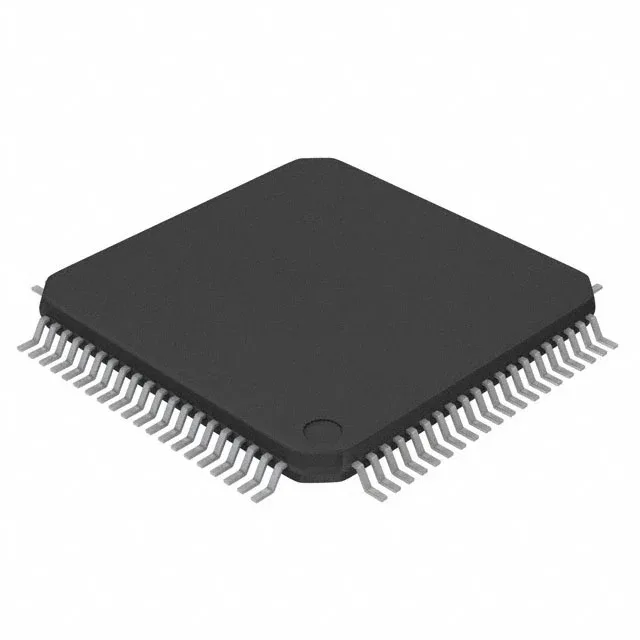
Dual-core ARM Cortex-M0+ and M4F — one chip, two jobs
The Infineon CYT2B94CACQ0AZSGST is a Traveo T2G family MCU built around a 32-bit dual-core architecture pairing an ARM Cortex-M0+ with an ARM Cortex-M4F. The M4F handles the math-heavy work — control loops, sensor fusion, signal processing — at up to 160 MHz, while the M0+ runs system management, communications, and safety monitoring at up to 100 MHz. That split means you don't need a separate supervisor MCU or an RTOS tick stealing cycles from the control loop. Program memory is 2.0625 MB of Flash, backed by 256K x 8 of SRAM and a separate 128K x 8 EEPROM block. The EEPROM eliminates an external serial EEPROM for calibration and configuration data, saving board space and a BOM line.
Peripherals and connectivity — what's on the bus
The peripheral set covers brown-out detect, low-voltage detect, POR, PWM, WDT, DMA, and a cryptographic accelerator block with AES, SHA, and TRNG. The 52-channel 12-bit SAR ADC with 63 I/O means you can digitise a dozen analog signals and still have pins left for a parallel display or an external memory interface.