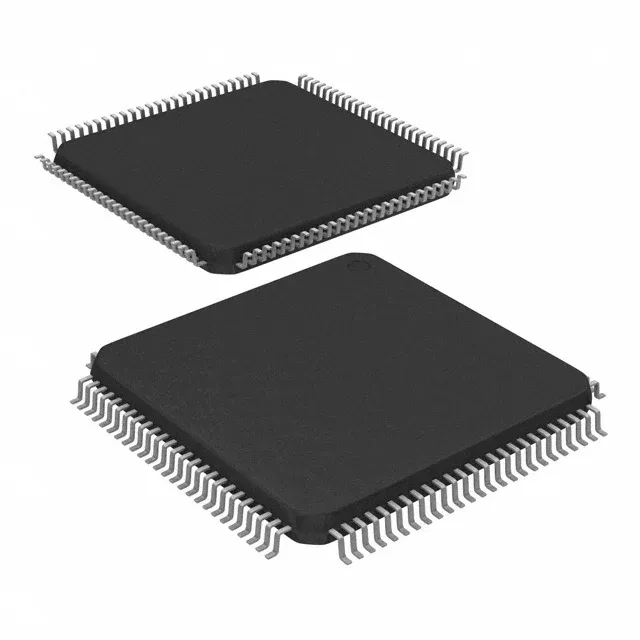
Core clock and processing headroom
The CY9BF412NPMC-G-JNE2: The ARM Cortex-M3 core runs at 144 MHz — that is the clock ceiling for the flash-wait-state profile, not just the CPU. At this speed the single-cycle multiply and bit-banding instructions keep control-loop jitter low enough for motor-field-oriented control without an external co-processor. 160 KB of on-chip FLASH (160K x 8) with 16K x 8 SRAM leaves room for a moderate RTOS kernel and a few communication stacks before running into code-size limits.
Supply voltage and I/O flexibility
The 83 general-purpose I/O pins include 5 V-tolerant inputs, so level-shifting is optional for legacy 5 V peripherals. On-chip peripherals include DMA, LVD, POR, PWM, and WDT — the watchdog and low-voltage detect are useful for fail-safe designs in unattended equipment.
Connectivity and analog interface
The connectivity set covers CANbus, CSIO, EBI/EMI, I²C, LINbus, and UART/USART — enough for industrial fieldbus gateways or multi-protocol sensor hubs. The external bus interface (EBI/EMI) allows memory-mapped expansion for displays or FPGAs. A 16-channel 12-bit ADC (A/D 16x12b) captures analog signals from multiple sensors without an external multiplexer. The internal oscillator eliminates the crystal for cost-sensitive builds, though an external clock can still be used for tighter timing accuracy.
Infineon has not issued a PCN or EOL notice for this FM3 MB9B410R series variant. ROHS3 compliance is confirmed.