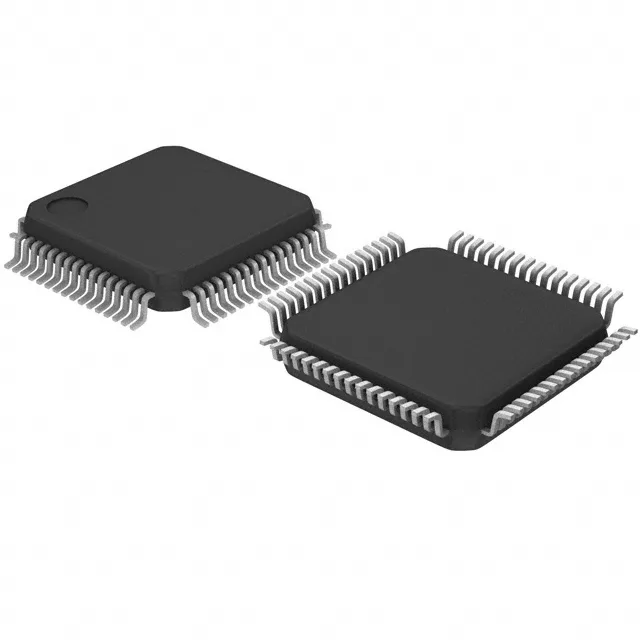
72 MHz Cortex-M3 — throughput for control and protocol processing
The CY9BF122LPMC1-G-MNE2: The ARM Cortex-M3 core runs at 72 MHz, delivering roughly 90 DMIPS. That is enough headroom for a real-time control loop (motor FOC or PID at 10-20 kHz) plus a communication stack (Modbus RTU or CANopen) running concurrently without a separate protocol coprocessor.
Memory budget — 160 KB flash, 16 KB RAM
Program memory is 160 KB of flash, arranged as 160K x 8. For a typical industrial application — say a pump controller with Modbus — the HAL, RTOS kernel, and application code fit inside 120 KB, leaving 40 KB for field-upgradeable parameter tables or a bootloader. The 16 KB SRAM (16K x 8) supports a modest stack and a few kB of DMA buffers; if your data logging or display buffer exceeds this, plan for external SRAM or a part from the higher-density MB9B siblings.
Supply range and temperature grade — single-rail industrial fit
The internal oscillator means no external crystal is needed for basic timing, though the PLL still requires a reference if you need the full 72 MHz.
Analog and connectivity — sensor interface on-chip
The 23-channel 12-bit ADC samples at rates sufficient for most sensor acquisition tasks — think thermocouple, pressure transducer, or current-sense inputs. Two 10-bit DAC channels provide analog setpoints or reference outputs. For serial links, the part carries CSIO (a clocked serial interface), I²C, LINbus, and UART/USART peripherals, covering the common industrial fieldbus and sensor protocols without external transceivers for short-haul links.
Compliance — RoHS3, no exemption risk
Infineon certifies this part as ROHS3 compliant (2011/65/EU + 2015/863). No exemptions are claimed, so the MCU ships without restricted substances and passes EU market entry checks without additional documentation. The part is also REACH and WEEE compliant per Infineon's standard declaration.